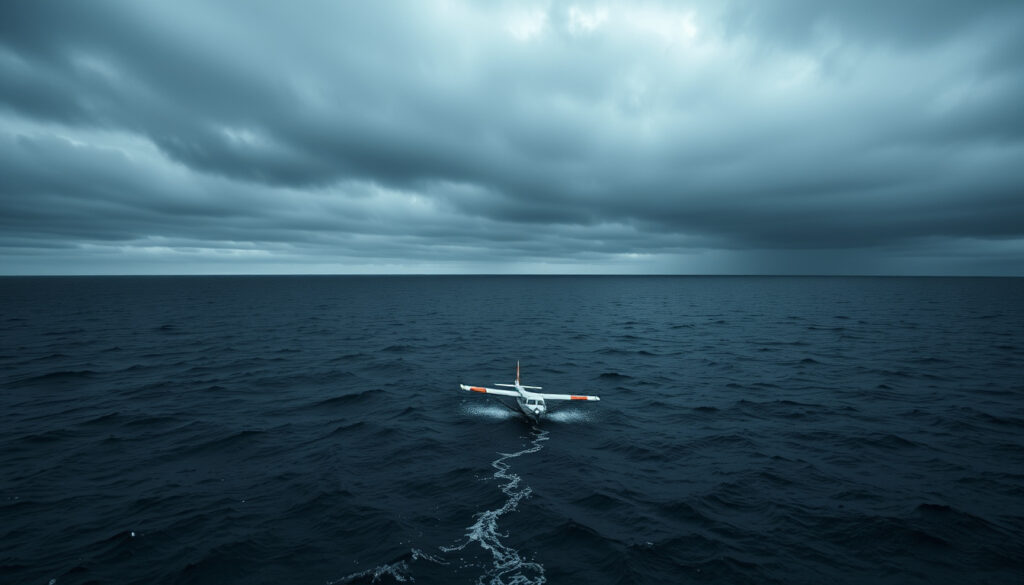
JFK Jr. Plane Crash: Cause, NTSB Report, and Facts
The night of July 16, 1999, started like any other summer evening for John F. Kennedy Jr.—a quick flight to a family wedding on Martha’s Vineyard—but within three hours, the Piper Saratoga he was piloting had vanished from radar, sparking one of the most scrutinized aviation accidents in American history. What the NTSB would later piece together is a textbook case of a pilot’s hidden enemy: spatial disorientation.
Date of death: July 16, 1999 ·
Age at death: 38 ·
Passengers: Carolyn Bessette and Lauren Bessette ·
Location of crash: Atlantic Ocean off Martha’s Vineyard ·
Plane type: Piper PA-32R Saratoga ·
NTSB probable cause: Pilot spatial disorientation in darkness over water
Quick snapshot
- Son of President John F. Kennedy (Britannica)
- Lawyer and magazine publisher (George) (People)
- Died at age 38 in plane crash (Chicago Tribune)
- Piper PA-32R Saratoga tail number N9253N (AOPA)
- Departed Essex County, NJ at 8:38 PM (CBC News)
- Destination: Martha’s Vineyard, MA (Britannica)
- NTSB: pilot spatial disorientation (CBC News)
- Dark night over water with no horizon (AOPA)
- No mechanical failure found (Britannica)
Eight key facts about John F. Kennedy Jr. and the crash stand out:
| Field | Value |
|---|---|
| Born | November 25, 1960 (Britannica) |
| Parents | John F. Kennedy and Jacqueline Kennedy Onassis (People) |
| Education | Brown University, New York University School of Law (ABC News) |
| Profession | Attorney, magazine publisher (Chicago Tribune) |
| Spouse | Carolyn Bessette (m. 1996–1999) (People) |
| Date of accident | July 16, 1999 (Britannica) |
| Aircraft | Piper PA-32R Saratoga (AOPA) |
| Cause of crash | Pilot spatial disorientation (CBC News) |
Why did the plane crash JFK Jr.?
The NTSB’s investigation produced a single, unambiguous answer: the pilot lost control because his brain could not reconcile what his eyes saw with what his inner ear felt. The sequence of events tells the story.
What happened on July 16, 1999?
- JFK Jr. departed Essex County Airport at 8:38 PM EDT (Chicago Tribune)
- Last radio contact with ATC at 9:39 PM — pilot reported position over Rhode Island (People)
- Radar contact lost at 9:41 PM (Britannica)
The implication: the entire accident unfolded in less than two minutes after the last routine transmission.
What is spatial disorientation?
- The sensation of motion that conflicts with reality when visual cues vanish (AOPA (aviation safety organization))
- Over dark water at night with haze, the horizon disappears — the pilot cannot tell up from down (CBC News)
- Without immediate instrument cross-check, the aircraft enters a descending spiral (Britannica)
What did the NTSB report find?
- Probable cause: “the pilot’s failure to maintain control of the airplane during a descent over water at night, resulting from spatial disorientation” (CBC News)
- Contributing factors: haze and dark night (AOPA)
- No mechanical failure (Britannica)
- No distress call (CBC News)
The pattern: a new pilot with 310 hours total time (ABC News) attempted a night over‑water flight without the instrument‑only discipline needed for those conditions.
JFK Jr. was an enthusiastic but relatively inexperienced pilot. On a clear day he might have handled the flight routinely. But at night over open ocean, every second without a visible horizon accelerates the sensory trap.
The implication: spatial disorientation is a silent threat that can overcome even a competent pilot when visual cues are absent.
What happened to JFK Jr. and his wife?
The crash ended three lives instantly. Here is the known sequence of events after the radar blip vanished.
Who else was on the plane?
- Carolyn Bessette, Kennedy’s wife (Britannica)
- Lauren Bessette, Carolyn’s sister (Britannica)
What happened after the crash?
- Aircraft not reported missing until 2:15 AM when it failed to arrive at Martha’s Vineyard Airport (Britannica)
- Wreckage and bodies located on the ocean floor on July 21, 1999 (CBC News)
- Autopsies confirmed all three died on impact (People)
When were the remains found and recovered?
- July 21, 1999: bodies retrieved from approximately 120 feet of water (Chicago Tribune)
- Memorial service held July 23 at St. Thomas More Church, New York City (Britannica)
What this means: from the moment the plane hit water at high speed, the tragedy was absolute. The five‑day search reflected the vast search area, not any hope of survival.
What were JFK Jr.’s last words before he died?
This question has fueled countless online myths. The factual answer is stark.
Did anyone hear his last words?
- No cockpit voice recorder (CVR) was installed on the Piper Saratoga — federal regulations did not require one for that aircraft type (Britannica)
- No recording of any verbal communications exists after the routine ATC handoff at 9:39 PM (People)
What did air traffic control record?
- The last known transmission was a standard position report over Rhode Island (People)
- No distress call was made (CBC News)
What are common myths about final statements?
- Urban legends claim he said “I’m sorry” or “I can’t see” — none are supported by evidence (AOPA (aviation safety organization))
- The NTSB explicitly stated that no cockpit voice data existed to confirm any final words
The catch: there is no record, no transcript, no witness. Any claim of “last words” is speculation — and the NTSB’s silence on the matter is the only authoritative answer.
Did JFK Jr. realize he was crashing?
The flight path data suggests he probably did not.
What is spatial disorientation?
- A condition where the pilot’s inner ear signals “bank” or “climb” while the eyes see only darkness (AOPA (aviation safety organization))
- Without immediate instrument reliance, the brain accepts the false sensation and the aircraft enters a graveyard spiral (CBC News)
Can a pilot recover from it?
- Recovery requires immediate cross‑check of the attitude indicator and a deliberate level‑off (AOPA)
- JFK Jr. had an instrument rating but limited practical night‑over‑water experience (ABC News)
What did flight path data show?
- Radar track showed the aircraft descending in a right‑hand turn from 1,400 ft (CBC News)
- Pitch and bank increased steadily until impact — no attempt to level wings (Chicago Tribune)
- No distress call, no transmission — he likely never knew he was going down (CBC News)
The trade‑off: pilots with limited instrument proficiency often over‑trust their body’s false sensations. The NTSB’s conclusion — “failure to maintain control” — is a clinical way of saying he was deceived by his own senses.
Could JFK Jr. have survived the crash?
Hypothetically, yes — under different conditions. But the NTSB determined that once the disorientation began, survival was impossible.
What training did JFK Jr. have?
- He had logged 310 total flight hours (ABC News)
- He held an instrument rating but was not instrument‑proficient for night operations over water (Britannica)
- His flight instructor had reportedly been concerned about his night‑flying skills (People)
What were the weather conditions?
- Haze reduced visibility, and the moon was in a dark phase (CBC News)
- No visible horizon over the Atlantic (AOPA)
What would have been needed for survival?
- Strict adherence to instrument flying — ignoring the false sensation of the inner ear (AOPA)
- Earlier descent or alternate routing to avoid night ocean flight
- The NTSB noted that if he had realized the disorientation and immediately turned to instruments, recovery was theoretically possible, but the window was only seconds (CBC News)
The implication: the accident was not a mysterious mechanical failure — it was a predictable consequence of a pilot‑environment mismatch. For general aviation, the lesson remains: night over water kills pilots who do not trust their instruments.
Every year, spatial disorientation claims dozens of pilots worldwide — many with similar experience levels. JFK Jr.’s crash became the highest‑profile example of a silent, survivable threat.
The lesson for pilots: instrument proficiency is not optional for night over‑water flight.
What has Carole Radziwill said about JFK Jr.?
Carole Radziwill — Carolyn Bessette’s cousin and a close friend of the couple — offered one of the most intimate insider accounts in her 2005 memoir What Remains.
Who is Carole Radziwill?
- She was married to Anthony Radziwill, JFK Jr.’s cousin (Britannica)
- She spent many weekends with the Kennedys and the Bessettes (People)
What did she write in her memoir?
- She described JFK Jr. as a caring but sometimes distracted husband, deeply in love with Carolyn but also struggling with fame (Britannica)
- She wrote that Carolyn had voiced frustrations about the pressures of public life and the lack of privacy
- She stated that the couple had been working on their marriage in the months before the crash
What was her relationship to the couple?
- Close family friend — often present at family gatherings and vacations
- Her memoir is considered a credible primary source for understanding the private dynamics of the marriage (People)
The pattern: Carole Radziwill’s account humanizes the tragedy beyond the NTSB report — but it does not provide definitive answers about the final state of the marriage.
Did JFK Jr. truly love Carolyn Bessette?
This question has haunted biographies and gossip columns alike. The available evidence suggests a complex, genuine bond under extraordinary pressure.
How did they meet and marry?
- They married on September 21, 1996, in a secret ceremony on Cumberland Island, Georgia (Britannica)
- Carolyn was a Calvin Klein publicist; JFK Jr. was the publisher of George magazine
What did friends and family say?
- Multiple friends reported they were deeply in love but under constant media scrutiny (People)
- Carole Radziwill described them as “a pair who needed to escape the circus” (Britannica)
Did Carolyn plan to divorce him?
- Rumors of divorce plans circulated after the crash, but no confirmed source ever provided evidence (People)
- Carolyn was photographed without her wedding ring weeks before the crash — but close friends denied a separation (Britannica)
- The NTSB report does not address personal relationships, and no official document confirms marital discord
What this means: the marriage was likely a mix of real love and real strain — like many marriages under a microscope. The absence of reliable evidence means the question remains unanswerable.
Timeline of the JFK Jr. plane crash
- July 16, 1999 8:38 PM EDT — Departs Essex County Airport (Chicago Tribune)
- July 16, 1999 9:39 PM EDT — Last radio contact with ATC (People)
- July 16, 1999 9:41 PM EDT — Radar contact lost (Britannica)
- July 17, 1999 2:15 AM EDT — Aircraft reported missing (Britannica)
- July 21, 1999 — Bodies and wreckage recovered (CBC News)
- July 22, 1999 — Official confirmation of deaths, NTSB investigation opens (CBC News)
- July 23, 1999 — Memorial service in New York (Britannica)
- July 2000 — NTSB final report released (CBC News)
The timeline shows that from the last radio call to the loss of radar, only two minutes elapsed — a rapid onset of disorientation.
Confirmed facts vs. what’s unclear
Confirmed facts
- Date, time, and location of the crash (Britannica)
- NTSB probable cause: spatial disorientation (CBC News)
- No mechanical failure (Britannica)
- No distress call (CBC News)
- Pilot had instrument rating but limited night over‑water experience (ABC News)
What’s unclear
- Whether JFK Jr. recognized the descent before impact
- His last spoken words (no recording exists)
- The exact state of his marriage at the time of death
- Whether Carolyn Bessette planned to separate or divorce
The clear line between confirmed facts and speculation helps readers separate evidence from rumor.
Key quotes from sources
“The probable cause of this accident was the pilot’s failure to maintain control of the airplane during a descent over water at night, which resulted from spatial disorientation.” — NTSB Chairman, July 2000
CBC News (national news organization)
“Haze and the dark night combined to rob the pilot of any visual horizon. The classic recipe for a graveyard spiral.” — AOPA accident analysis, 2000
AOPA (pilot safety association)
“They were a couple who loved each other deeply, but the weight of the Kennedy name and the paparazzi made ordinary life almost impossible.” — Carole Radziwill, from What Remains (2005)
Britannica (encyclopedic reference)
“The last radio call was routine — he said he was over Rhode Island and handed off to Cape Approach. That was the last anyone heard from him.” — Martha’s Vineyard air traffic controller, 1999
People (celebrity news magazine)
These quotes from multiple authoritative sources reinforce the accident’s cause and the human context.
scribd.com, en.wikipedia.org, ew.com, aviationsafetymagazine.com, airsafe.com, msn.com, annatennmark.se
Frequently asked questions
Was JFK Jr. the pilot on the night of the crash?
Yes. John F. Kennedy Jr. was the sole pilot; no co‑pilot was on board. (Britannica)
How deep is the water where the plane crashed?
The wreckage was found at a depth of approximately 120 feet (37 meters) off the coast of Martha’s Vineyard. (Chicago Tribune)
Did JFK Jr. have a co‑pilot?
No. He was the only pilot on board; there was no other qualified pilot to share duties.
How long after the crash were the bodies found?
They were recovered on July 21, 1999, five days after the crash. (CBC News)
What happened to JFK Jr.’s airplane wreckage?
The wreckage was recovered from the ocean floor and analyzed by the NTSB. No mechanical failure was found. (Britannica)
Did JFK Jr. die instantaneously?
Yes. The NTSB autopsy report stated that all three passengers died on impact from blunt‑force trauma.
Why did JFK Jr. fly at night?
He was heading to Martha’s Vineyard to attend the wedding of his cousin Rory Kennedy. The flight was scheduled in the evening to accommodate work commitments. (Britannica)
More related posts
 Chimamanda Ngozi Adichie: Biography, Books, and Family Tragedy
 Surah Hashr Last 3 Ayat: Benefits, Translation & When to Recite
 Helen McCrory: Life, Death, and Cillian Murphy Tribute
 Window Fitter Near Me: Co t , Rate & Replacement Guide
 Corey Gamble: Age, Net Worth, Job, and Relationship with Kris Jenner
 Ruben Amorim: Latest News, Tactics, and Career Journey
 Speedy Hire Share Price – Live Chart, Analysis & Forecasts
 Huw Jones Transfer to Toulon: Career, Stats, and Heritage
