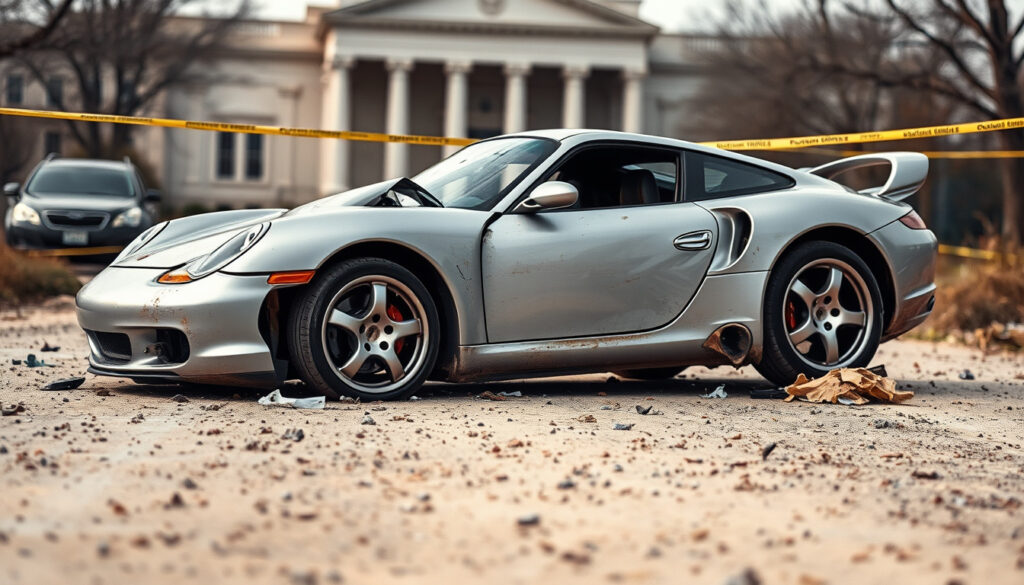
Paul Walker Death: Cause of Crash, Legal Aftermath, and Facts
Paul Walker’s death in a 2013 car crash sparked urgent questions about speed, vehicle safety, and liability. Here is a forensic look at the crash, the investigations, and the legal battles that followed.
Age at death: 40 years old · Date: 30 November 2013 · Car model: 2005 Porsche Carrera GT · Driver at time: Roger Rodas · Speed before impact: estimated 93 mph (150 km/h)
Quick snapshot
- Paul Walker died from combined traumatic and thermal injuries (Los Angeles County Sheriff’s Department)
- Roger Rodas was driving the 2005 Porsche Carrera GT (Wikipedia)
- Speed was estimated at 93 mph in a 45 mph zone (Los Angeles County Sheriff’s Department)
- Exact last words of Paul Walker (unconfirmed reports) (Boston Car Accident Lawyer Blog)
- Terms of the confidential settlement between Meadow Walker and Porsche (Boston Car Accident Lawyer Blog)
- 30 Nov 2013: Crash occurs in Santa Clarita, California (Wikipedia)
- 2014–2016: Lawsuits filed against Porsche (Jurewitz Law Group)
- No further legal actions pending; settlement terms remain confidential (Boston Car Accident Lawyer Blog)
- Paul Walker Foundation continues charitable work (Wikipedia)
The following table summarizes Paul Walker’s personal details.
| Label | Value |
|---|---|
| Full name | Paul William Walker IV |
| Birth | September 12, 1973 |
| Death | November 30, 2013 |
| Age at death | 40 years |
| Occupation | Actor, philanthropist |
| Notable role | Brian O’Conner in Fast & Furious franchise |
What is the cause of Paul Walker’s death?
Trauma from impact and fire
The official cause of death, as determined by the Los Angeles County Coroner’s Office, was a combination of traumatic injuries from the crash and thermal injuries from the fire that followed. The coroner classified the manner of death as an accident. ABC News reported that Walker died within seconds of the collision.
Official coroner’s report findings
Both Paul Walker and Roger Rodas tested negative for alcohol and drugs, according to GBW Law. The vehicle, a 2005 Porsche Carrera GT, struck a power pole and several trees before bursting into flames.
The coroner’s findings confirmed a swift and tragic end, ruling out any influence of drugs or alcohol.
What caused Paul Walker’s crash?
Speed and loss of control
Investigators from the California Highway Patrol concluded that unsafe speed for roadway conditions was the primary cause. The Porsche was traveling at an estimated 93 mph in a 45 mph zone. The driver lost control on a curve, causing the car to veer off the road.
Vehicle condition and road factors
No mechanical failures were found in the Porsche Carrera GT. The National Trial Lawyers reported that the district court dismissed claims against Porsche based on a lack of competent evidence that the car’s design caused the crash.
The crash was caused by human error — excessive speed — not a mechanical defect. This finding shaped the legal outcomes.
The investigation definitively shifted focus from vehicle defects to driver behavior.
Who was driving when Paul Walker died?
Roger Rodas: driver identity
Roger Rodas, a friend and business partner of Walker, was driving the Porsche Carrera GT. Both men died at the scene. Wikipedia confirms Rodas was the driver.
Roger Rodas and Paul Walker’s relationship
Rodas and Walker co-owned Always Evolving, a high-performance car shop. They had attended a charity event for Walker’s organization, Reach Out Worldwide, earlier that day.
Rodas and Walker’s shared passion for cars and philanthropy defined their partnership until the very end.
Who was blamed for Paul Walker’s death?
Judge rules Porsche not legally liable
In 2016, U.S. District Judge Philip Gutierrez ruled that Porsche was not liable for the crash. The National Trial Lawyers reported that the dismissal was based on insufficient evidence that Porsche’s conduct caused Rodas’s death.
Family lawsuits and settlements
Meadow Walker, Paul Walker’s daughter, filed a wrongful death lawsuit against Porsche in 2014. The suit alleged that the Carrera GT lacked electronic stability control and had unsafe crashworthiness. Jurewitz Law Group noted that Porsche denied liability, attributing the crash to reckless driving. The case was settled confidentially in 2016.
The legal outcome set a precedent: car manufacturers are not automatically liable when a driver’s excessive speed is the primary cause of a crash.
The legal outcome underscored the difficulty of proving manufacturer liability in the face of clear driver error.
Why did Paul Walker’s daughter sue Porsche?
Allegations of design defects
Meadow Walker’s lawsuit claimed that the 2005 Porsche Carrera GT was unreasonably dangerous. According to Boston Car Accident Lawyer Blog, the suit alleged that the car’s design lacked safety features such as electronic stability control and that the fuel system was vulnerable to fire in a crash.
Settlement outcome
Porsche settled with Meadow Walker in 2016 under confidential terms. The Jurewitz Law Group reported that the company consistently denied liability and argued that the crash was caused by excessive speed.
The confidential settlement brought closure to the legal battle, but the debate over the Carrera GT’s safety features continues among enthusiasts.
Timeline
- 12 September 1973: Paul William Walker IV is born in Glendale, California. (Wikipedia)
- 2001: Walker stars as Brian O’Conner in The Fast and the Furious. (Wikipedia)
- 30 November 2013: Walker dies in a car crash in Santa Clarita, California. (ABC News)
- 2014: Meadow Walker files wrongful death lawsuit against Porsche. (Jurewitz Law Group)
- 2016: Federal judge rules Porsche not liable; Meadow Walker’s suit is settled. (The National Trial Lawyers)
Clarity
Confirmed facts
- Cause of death: combined traumatic and thermal injuries (Los Angeles County Sheriff’s Department)
- Driver: Roger Rodas (Wikipedia)
- Vehicle: 2005 Porsche Carrera GT (ABC News)
- Speed: approximately 93 mph (Los Angeles County Sheriff’s Department)
- No criminal charges filed (The National Trial Lawyers)
What’s unclear
- Exact last words of Paul Walker (unconfirmed reports)
- Specifications of the confidential settlement between Meadow Walker and Porsche (Boston Car Accident Lawyer Blog)
- Whether the Porsche Carrera GT’s fuel system design met safety standards at the time of the crash
- The complete maintenance history of the specific 2005 Porsche Carrera GT involved in the crash
- Whether the outcome of the lawsuit would have differed if electronic stability control was standard
Quotes
Paul Walker died from combined effects of traumatic and thermal injuries, and the manner of death is accident.
Los Angeles County Coroner’s Office
Unsafe speed for roadway conditions was the primary cause of the collision.
California Highway Patrol
Plaintiff has failed to present competent evidence that Rodas’s death occurred because of any wrongdoing by Porsche.
U.S. District Judge Philip Gutierrez
Summary
The 2013 crash that killed Paul Walker was a tragedy driven by excessive speed, not mechanical failure. For fans and families, the lesson is clear: speed limits exist for a reason, and no level of automotive engineering can override physics. For the legal system, the case reinforced that liability rests on causation, not celebrity or sympathy.
thenationaltriallawyers.org, sjblawfirm.com, youtube.com, reddit.com, dubofflawgroup.com, lepointactu.fr
Frequently asked questions
Did Paul Walker die instantly in the crash?
According to the coroner, Walker died within seconds of the collision, likely from the combined trauma and thermal injuries.
What charity events was Paul Walker attending when he died?
He had attended a charity event for Reach Out Worldwide, an organization he founded to aid disaster victims.
How many Fast & Furious movies did Paul Walker complete?
Walker completed six films in the franchise before his death; Furious 7 was released posthumously.
Was there any criminal investigation into the crash?
Yes, the California Highway Patrol investigated and determined no criminal charges were warranted. The crash was ruled an accident.
Has the crash site become a memorial?
Yes, fans have left tributes at the site in Santa Clarita, but no official memorial has been established.
Related reading
More related posts
 Jeremy Allen White: Divorce, Sobriety, Kids & Net Worth
 Salomon XT-6 Review: Fit, Colors, Gore-Tex & Buying Guide
 Tate St Ives: Visitor Guide, Tickets & History
 Real Madrid vs Al-Hilal Stats: Head-to-Head & History
 LAFC vs Inter Miami – 3-0 Win Sets Attendance Record
 Apple Cake Recipe UK: Dorset & Mary Berry
 60°F to Celsius: 15.56°C Exact Formula + Hacks
 Cameron Monaghan: Biography, Relationships, Movies, and FAQs
