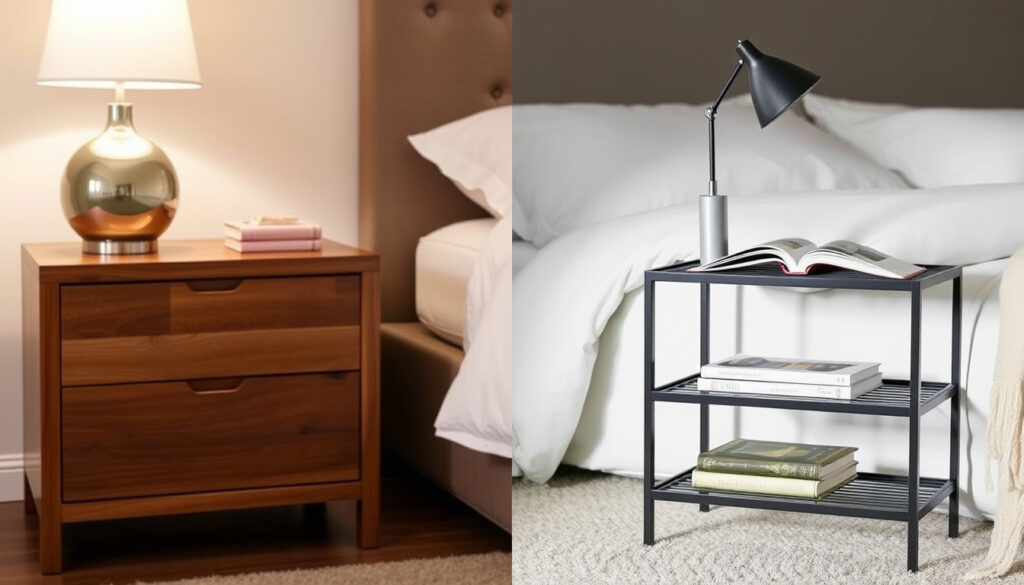
Bedside Tables Buying Guide: Sizes, Materials & Styles
The right bedside table transforms a bedroom from inconvenient to effortless, yet many buyers prioritise looks over fit. This guide walks through the practical sizing, material trade-offs, and style families available from Irish retailers, so you can pick a piece that fits both your space and your habits.
Average price range: €50–€200 ·
Most common material: Wood (solid or engineered) ·
Standard width range: 40–60 cm ·
Typical height: 50–65 cm ·
Number of major brands in Ireland: At least 5 (IKEA, JYSK, Laura James, Woodesign, Corcorans)
Quick snapshot
- Bedside tables are available in wood, metal, and engineered materials (IKEA Ireland, major flat-pack retailer)
- Several Irish retailers stock bedside tables (JYSK Ireland, Scandinavian furniture chain)
- Height should align with mattress top for comfort (Michael Murphy Home Furnishing, Irish furniture specialist)
- Whether bedside lockers are significantly more secure than open tables
- The exact impact of bedside table style on sleep quality
- IKEA Ireland’s bedside tables page last updated April 2026 (IKEA Ireland, major flat-pack retailer)
- JYSK Ireland’s page last updated May 2026 (JYSK Ireland, Scandinavian furniture chain)
- Laura James Ireland’s collection last updated August 2025 (Laura James Ireland, specialist furniture retailer)
- Expect more hybrid designs combining drawers and open shelves
- Second-hand markets like DoneDeal and Adverts.ie remain strong alternatives for budget buyers
Irish retailers consistently cluster around a narrow height band that matches standard mattress depths, as the table below shows.
| Specification | Value |
|---|---|
| Average price | €50–€200 |
| Most popular material | Solid wood |
| Most common width | 50-60 cm |
| Top brand in Ireland | IKEA |
| Typical height range | 50-65 cm |
What are the standard sizes for bedside tables?
Common width ranges (40–60 cm)
- Most Irish retailers stock widths between 50 cm and 60 cm, which fits beside a standard double or king bed without crowding the room (Michael Murphy Home Furnishing, Irish furniture specialist).
- Narrower models (40–45 cm) suit small bedrooms or single beds, while wider pieces (60 cm+) work in larger master suites.
Height guidelines relative to mattress top
- The ideal bedside table height matches the top of your mattress — typically 50–65 cm — so you don’t have to reach up or down for items (PouffeLOVE, Irish home-interior guide).
- If your bed frame is unusually high or low, measure from the floor to the mattress top before shopping.
Depth considerations for small bedrooms
- Depth rarely exceeds 45 cm in Irish retail stock, which prevents the table from protruding too far into walking space (Meubles, Irish furniture retailer).
- A depth of 35–40 cm is common for compact rooms, leaving enough clearance for a bedside lamp and a book.
A table that’s too tall forces you to lift your arm awkwardly; one that’s too low means bending down. Irish buyers who measure mattress height first save themselves years of minor irritation.
The implication: getting height right matters more than any other dimension.
How do I choose the best bedside table?
Assess your storage needs
- If you keep books, glasses, and a phone charger bedside, a single drawer hides the clutter. If you prefer quick access to a tablet or magazine, an open shelf works better (JYSK Ireland, Scandinavian furniture chain).
- Hybrid designs — one drawer plus one shelf — offer balanced storage for most people.
Consider room size and layout
- Measure the gap between your bed and the wall or wardrobe. A table that’s too wide will block access or feel cramped.
- In a small room, a wall-mounted shelf can serve as a bedside table without taking floor space.
Match style to existing bedroom furniture
- Scandinavian designs from JYSK or IKEA pair well with light wood floors and neutral bedding (IKEA Ireland, major flat-pack retailer).
- Art Deco pieces from Laura James add brass accents and geometric shapes that complement darker, richer colour schemes (Laura James Ireland, specialist furniture retailer).
Budget planning
- IKEA offers flat-pack options from around €30, while solid-wood pieces from Woodesign or Corcorans can exceed €200.
- Second-hand listings on DoneDeal and Adverts.ie often have discounted pieces — about 1,000 listings were active recently (Adverts.ie, Irish peer-to-peer marketplace).
The pattern: practical constraints should drive the decision, not aesthetics.
What materials are commonly used for bedside tables?
Solid wood (oak, pine, walnut)
- Solid wood is the most durable and expensive option, with oak and walnut pieces lasting decades (Murphy Furniture, Irish furniture maker).
- Pine is lighter and more affordable, but softer and prone to dents.
Engineered wood (MDF, particleboard)
- MDF is budget-friendly and widely used by IKEA and JYSK. It resists warping but can chip if moved repeatedly (IKEA Ireland, major flat-pack retailer).
- Particleboard is cheaper still, but less durable — avoid it for tables that will hold heavy lamps or devices.
Metal and glass
- Metal frames (often steel or aluminium) are lightweight and suit modern or industrial bedrooms. Glass shelves add a sleek look but show dust and fingerprints.
- Wayfair Ireland markets several metal-and-glass designs online (Wayfair Ireland, online furniture marketplace).
Eco-friendly options
- Some Irish retailers now offer tables made from reclaimed wood or FSC-certified timber. These tend to cost more but appeal to environmentally conscious buyers.
- Bamboo is a fast-growing alternative that’s naturally moisture-resistant.
Material choice directly affects longevity and maintenance. A solid-oak table costs three times an MDF one but will outlast it by decades — a real consideration for anyone furnishing a long-term home.
What this means: your budget and expected lifespan together determine the right material choice.
Are bedside tables with drawers better than open shelves?
Pros and cons of drawers
- Drawers hide clutter — chargers, medications, and notebooks stay out of sight. But they require more vertical space and can be harder to access if the table is low (PouffeLOVE, Irish home-interior guide).
- Drawers also collect dust and need occasional cleaning inside.
Pros and cons of open shelves
- Open shelves allow quick access to books, a tablet, or a decorative tray. They also make a small room feel less boxed in.
- The downside: everything on display must be tidy, or the table looks messy.
Hybrid designs (drawer + shelf)
- Many Irish retailers stock hybrid models — a small drawer on top for hidden items and an open shelf below for books or baskets (Meubles, Irish furniture retailer).
- This is the most versatile option for most bedrooms.
Best use cases for each
- Drawers: best for people who keep multiple small items (glasses, remotes, chargers) and want a clean look.
- Open shelves: best for minimalists or anyone who reads in bed and wants books within arm’s reach.
- Hybrid: best for families or shared bedrooms where one person needs storage and the other wants display space.
The catch: there is no universal winner — your habits dictate the right storage configuration.
Where can I buy bedside tables in Ireland?
Online retailers (IKEA, JYSK, Laura James, Woodesign)
- IKEA Ireland offers affordable flat-pack options with delivery across the island (IKEA Ireland, major flat-pack retailer).
- JYSK provides Scandinavian designs at mid-range prices (JYSK Ireland, Scandinavian furniture chain).
- Laura James specialises in Shaker and Art Deco styles with a focus on quality finishes (Laura James Ireland, specialist furniture retailer).
- Woodesign offers solid-wood, Irish-made pieces for those prioritising craftsmanship.
High street stores (Harvey Norman, Woodie’s)
- Harvey Norman stocks a wide range of bedside lockers and tables, often with in-store displays so you can test height and feel (Goldenpages.ie, Irish business directory).
- Woodie’s carries budget-friendly options, especially in engineered wood.
Second-hand options (DoneDeal, Facebook Marketplace)
- DoneDeal and Adverts.ie regularly list hundreds of used bedside tables, often at 40–60% below retail (Adverts.ie, Irish peer-to-peer marketplace).
- Facebook Marketplace is another active channel, especially for solid-wood pieces from local sellers.
Comparing prices and delivery
- IKEA and Wayfair offer free delivery over certain thresholds; smaller retailers may charge €10–€20 (Wayfair Ireland, online furniture marketplace).
- Second-hand purchases require self-collection, but the savings often justify the trip.
Irish buyers have more choice than ever — but the best deal isn’t always the cheapest. A €40 IKEA table may serve a student flat for three years; a €180 solid-wood piece from Woodesign will last a lifetime.
The pattern: the real cost of a bedside table includes how long you plan to keep it.
“Our bedside tables span minimalist Scandinavian designs and timeless classics — it’s about finding the right balance between form and function for your space.”
— JYSK Ireland product description (JYSK Ireland, Scandinavian furniture chain)
“We offer bedside tables in a range of finishes and sizes to fit your bedroom space and style — from Shaker simplicity to Art Deco glamour.”
— Laura James Ireland (Laura James Ireland, specialist furniture retailer)
For Irish shoppers, the bedside-table market is rich with options — but the sheer variety can be overwhelming. The pattern across all retailers is clear: height and width are the non-negotiable starting points. Everything else — material, drawer count, style — is a preference, not a requirement.
Related reading: Bedside Tables Ireland: A Complete Buying Guide · Bedside Tables at Michael Murphy Home Furnishing
For budget-conscious shoppers, Kmart bedside table options offer a practical alternative to traditional furniture store finds.
Frequently asked questions
What is the difference between a nightstand and a bedside table?
In practice, the terms are interchangeable. “Nightstand” sometimes implies a smaller, lighter piece, while “bedside table” can refer to anything from a simple shelf to a large cabinet. Irish retailers use both labels for the same category.
Can I use a small desk as a bedside table?
Yes — a small desk (60–80 cm wide) can double as a bedside table and a workspace. Just ensure the height matches your mattress top, and leave enough room to open drawers or pull out a chair.
How to clean a wooden bedside table?
Dust weekly with a soft cloth. For spills, wipe immediately with a damp (not wet) cloth and dry. Avoid harsh chemicals — a mild soap-and-water solution is safest. Polish solid wood every 6–12 months with furniture wax or oil.
Do I need matching bedside tables on both sides of the bed?
Not necessarily. Matching tables create symmetry, which many find calming. But mismatched tables — one with drawers, one with a shelf — can work if they share a similar height and colour tone. The key is visual balance, not identicality.
Are bedside tables with USB ports useful?
Yes, if you charge your phone or tablet overnight. Built-in USB ports reduce cable clutter and eliminate the need for a separate adapter. However, they add cost and may become obsolete if charging standards change.
How do I prevent a bedside table from wobbling?
Check that all four feet sit flat on the floor — use furniture pads or a small shim if the floor is uneven. For flat-pack tables, tighten all screws and bolts. If the wobble persists, the frame may be warped; consider returning it.
What is the best height for a bedside table?
The best height is level with the top of your mattress — typically 50–65 cm. This allows you to reach items without stretching or bending. Measure your mattress height before buying, and bring a tape measure to the store.
For Irish buyers, the bedside-table decision comes down to one question: do you want a piece that disappears into the background, or one that makes a statement? The trade-off is clear: choose a table that fits your bed height and room dimensions first, then let style follow. A buyer who measures their mattress height before shopping avoids years of nightly frustration.
More related posts
 James Hetfield’s Health, Net Worth, Relationships, and Song Bans
 Katya Adler: BBC Europe Editor Biography
 B&Q Stockton-on-Tees: Store Guide, Services & Contact Info
 Ashley Barnes: Biography, Burnley Return, Stats & Career Update
 Emile Heskey: Age, Height, Wife, Net Worth & Career Stats
 Lara Raj: Ethnicity, Religion, Age, and Family – Full Profile
 Helen McCrory: Life, Death, and Cillian Murphy Tribute
 Who is Steve Bracknall? The Viral Sunday League Manager
