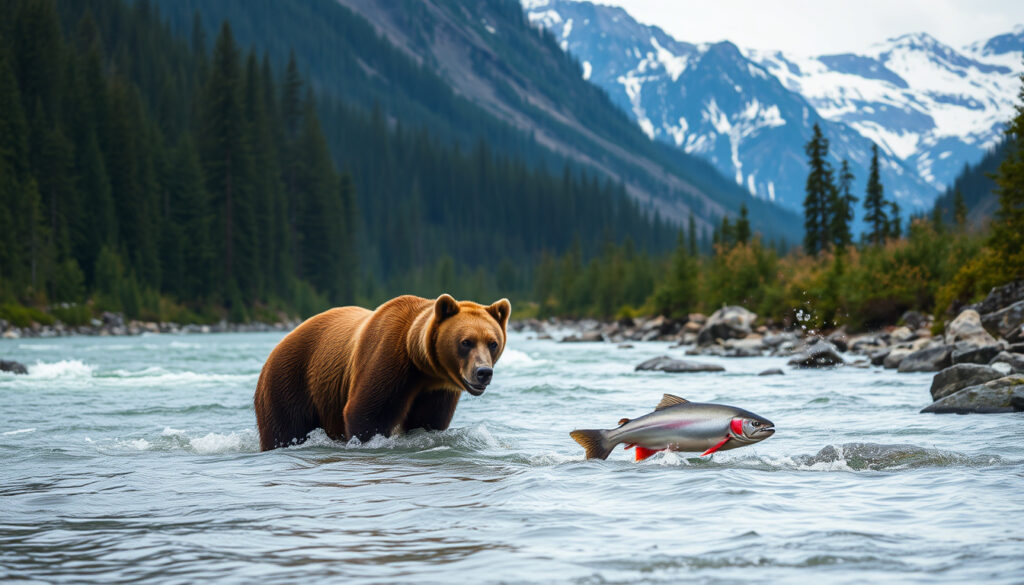
Grizzly Bear: Facts, Behavior, Aggression, and Conservation
Few sights in the North American wilderness command as much respect as a grizzly bear. Whether you’ve seen one from a safe distance in Yellowstone or only in documentaries, the blend of power and wariness these animals project is unforgettable. Here’s a grounded look at what science and wildlife management actually tell us about Ursus arctos horribilis — from its disputed name to its role as an apex predator in ecosystems across Alaska, Canada, and the northwestern United States.
Scientific name: Ursus arctos horribilis · Average weight (male): 400–790 lb (180–360 kg) · Height (standing): 6.5–8 ft (2–2.5 m) · Top speed: 30–35 mph (48–56 km/h) · Lifespan in wild: 20–25 years · Geographic range: Western Canada, Alaska, northwestern US
Quick snapshot
- Subspecies of brown bear (Ursus arctos) U.S. Fish & Wildlife Service (federal wildlife agency)
- Scientific name: Ursus arctos horribilis (U.S. Fish & Wildlife Service (federal wildlife agency))
- Closest relatives: Kodiak bear, Eurasian brown bear IELC LibGuides (zoological library)
- Weight: 200–790 lb (90–360 kg) U.S. Fish & Wildlife Service
- Height: 3.3 ft at shoulder, up to 8 ft standing (U.S. Fish & Wildlife Service)
- Distinct shoulder hump and long claws up to 5 inches (13 cm) Denver Zoo Conservation Alliance (accredited zoo)
- Omnivorous diet: berries, roots, salmon, carrion National Wildlife Federation (wildlife education nonprofit)
- Hibernation period: 5–7 months (National Wildlife Federation (wildlife education nonprofit))
- Home range: up to 600 sq mi (1,550 km²) for males (National Wildlife Federation (wildlife education nonprofit))
- Listed as threatened in contiguous US (Endangered Species Act) Defenders of Wildlife (conservation organization)
- Estimated 1,500 grizzlies in lower 48 states (Defenders of Wildlife (conservation organization))
- Stable populations in Alaska and Canada (Defenders of Wildlife (conservation organization))
These ten numbers — one pattern: the grizzly is a massive, long-lived omnivore that has been pushed to the edge of its historical range but still holds on in protected strongholds.
| Attribute | Value |
|---|---|
| Scientific name | Ursus arctos horribilis |
| Average male weight | 400–790 lb (180–360 kg) |
| Average female weight | 200–450 lb (90–200 kg) |
| Height (standing) | 6.5–8 ft (2–2.5 m) |
| Top speed | 30–35 mph (48–56 km/h) |
| Lifespan (wild) | 20–25 years |
| Diet | Omnivorous: berries, roots, salmon, carrion |
| Hibernation | 5–7 months per year |
| Population in lower 48 | Approximately 1,500 individuals |
| Conservation status (US) | Threatened (Endangered Species Act) |
These ten numbers — one pattern: the grizzly is a massive, long-lived omnivore that has been pushed to the edge of its historical range but still holds on in protected strongholds.
Which bear is more aggressive, a grizzly or a black bear?
Key differences in aggression between grizzly and black bears
- Grizzly bears are generally more aggressive than black bears, especially when defending cubs or food National Wildlife Federation.
- Black bears are more likely to flee than fight.
- Aggression varies by region, season, and individual bear history U.S. Fish & Wildlife Service.
Factors that influence bear aggression
Bear expert S. Herrero notes that “most grizzly attacks are defensive, not predatory.” The presence of cubs, food sources, and surprise encounters all spike defensive aggression. Research from EBSCO Research Starters (academic database) shows that grizzlies exhibit higher rates of defensive attacks than black bears in North America.
The implication: if you’re hiking in grizzly country, aggressive posturing is usually fear, not hunting. Still, the bear’s sheer power makes any charge dangerous.
Grizzlies are more aggressive per encounter, but black bears kill more people overall simply because they live closer to human populations. The trade-off between frequency and lethality is a key nuance in bear safety education.
Three traits, one pattern: grizzlies dominate in size and defensiveness, black bears in avoidance and adaptability.
| Trait | Grizzly bear | Black bear |
|---|---|---|
| Average weight (adult male) | 400–790 lb | 130–660 lb |
| Shoulder hump | Prominent | Absent |
| Attack tendency | Defensive, especially with cubs | Rarely attacks; typically flees |
The implication: encounter rates and defensive posture define the risk, not raw aggression alone.
Why are bears called grizzly?
Origin of the name “grizzly”
- The name “grizzly” comes from the bear’s grizzled or silver-tipped fur U.S. Fish & Wildlife Service.
- Alternatively, some sources suggest it derives from the word “grisly” meaning terrifying IELC LibGuides.
Historical naming from Lewis and Clark expedition
The first scientific description of the grizzly bear came in 1805 during the Lewis and Clark expedition. The explorers recorded a bear that was “grizzled” in appearance, and the name stuck. U.S. Fish & Wildlife Service notes that the subspecies name horribilis (meaning “horrible”) was added later, reflecting the bear’s fearsome reputation among early naturalists.
What this means: the name carries a double meaning — both a literal description of the coat and a nod to the awe the bear inspired. That duality captures the grizzly’s place in the American imagination.
What are 10 facts about grizzly bears?
Physical characteristics
- Grizzlies have a hump of muscle over their shoulders for digging Denver Zoo Conservation Alliance.
- They can run up to 35 mph (56 km/h) National Wildlife Federation.
- Front claws measure up to 5 inches (13 cm) Denver Zoo Conservation Alliance.
Diet and hunting behavior
- Grizzlies are omnivores; diet includes berries, roots, salmon, and small mammals National Wildlife Federation.
- They are skillful diggers, using claws to unearth roots and invertebrates.
Reproduction and lifespan
- Females give birth to 1–4 cubs during hibernation Defenders of Wildlife.
- They hibernate 5–7 months each winter.
- Lifespan in the wild is 20–25 years U.S. Fish & Wildlife Service.
Conservation status
- Grizzlies are listed as threatened under the Endangered Species Act in the lower 48 states Defenders of Wildlife.
- Population in the contiguous US is roughly 1,500 bears, up from fewer than 900 in 1975 Defenders of Wildlife.
The pattern: each fact reinforces a picture of an animal built for endurance and power, whose recovery hinges on human stewardship.
What smells do bears hate?
Effective bear repellents
- Bears dislike strong ammonia, bleach, and pine-based cleaners National Wildlife Federation.
- Commercial bear deterrent sprays (capsaicin) are effective Defenders of Wildlife.
Scents that attract vs. deter bears
Food odors are the strongest attractants: cooking smells, garbage, pet food, and even toothpaste. Proper food storage in bear-proof canisters is critical in backcountry areas. National Park Service (federal land management agency) bear safety guidelines emphasize that “a fed bear is a dead bear” — habituated bears that learn to associate humans with food often have to be euthanized.
The catch: no scent-based repellent is foolproof. Bear spray relies on direct aerosol contact with the bear’s eyes and nose, not smell aversion.
Some online advice touts ammonia-soaked rags as deterrents, but the National Park Service warns that strong chemical smells can actually attract curious bears. The safest deterrent remains distance, awareness, and proper food storage.
The implication: managing scent is about avoiding attractants more than relying on repellents — human behavior is the deciding factor.
What is the grizzly bear’s biggest enemy?
Natural predators and threats
- Adult grizzlies have no natural predators other than humans U.S. Fish & Wildlife Service.
- Cubs can be killed by wolves, mountain lions, or male grizzlies National Wildlife Federation.
Human impact and habitat loss
Humans pose the greatest threat through hunting, habitat destruction, and vehicle collisions. In the lower 48 states, grizzlies now occupy only about 2% of their historical range Center for Biological Diversity (environmental advocacy group). Roads, subdivisions, and energy development fragment the landscape, isolating populations and reducing genetic diversity.
The pattern: the same species that has no natural enemies is being squeezed by development and political debate over delisting. For the grizzly, human attitudes — not wolves or other predators — are the real existential threat.
What is the most aggressive bear in the world?
Aggression rankings by bear species
- Polar bears are considered the most aggressive towards humans due to food scarcity — they are the only bear species that actively hunts people National Park Service.
- Grizzly bears are highly defensive of cubs and food sources, but their attacks are overwhelmingly non-predatory National Wildlife Federation.
- Sloth bears and Asiatic black bears have documented high aggression rates in encounters, though data is less complete EBSCO Research Starters.
Role of polar bears and grizzlies
Among the eight bear species worldwide, polar bears are unique in that they regularly view humans as prey due to their high-energy, seal-based diet and Arctic habitat where food is scarce. Grizzly bears, by contrast, typically attack in defense — protecting cubs, a carcass, or reacting to a surprise encounter. National Park Service data shows that polar bear attacks are rarer but far more likely to be fatal per encounter.
The implication: “aggression” means different things in different bears — predatory in polar bears, defensive in grizzlies — and safety strategies must match the species.
Which bear has killed the most humans?
Statistics on fatal bear attacks
- Polar bears are responsible for the highest proportion of fatal attacks relative to encounters, though the absolute number is low National Park Service.
- Grizzly bears cause more total fatal attacks in North America than black bears — but black bears kill more people overall due to far greater population overlap with humans National Wildlife Federation.
- Black bear attacks are extremely rare and almost always defensive or associated with habituation to human food Defenders of Wildlife.
Species responsible for most human fatalities
When adjusted for encounter rates, grizzly bears are more lethal per encounter than black bears, but the raw number of black bear encounters is so much larger that black bears account for more total human fatalities in recent decades — a pattern driven by geography and proximity, not inherent aggression. Defenders of Wildlife tracks that the vast majority of bear encounters result in no injury, and fatal attacks across all species remain below one per year in North America.
The implication: the risk is real but statistically tiny compared to other outdoor hazards — the real challenge is managing human-bear coexistence, not eliminating risk entirely.
Six physical specs, one pattern: every measurement reflects a body built for power, endurance, and digging.
| Specification | Value |
|---|---|
| Shoulder height | 3.3–4.5 ft (1–1.4 m) |
| Standing height | 6.5–8 ft (2–2.5 m) |
| Front claw length | Up to 5 in (13 cm) |
| Skull length (adult male) | ~13–15 in (33–38 cm) |
| Tail length | 2.5–5 in (6–13 cm) |
| Largest recorded weight (male) | ~1,200 lb (544 kg) — Kodiak bear |
What’s settled and what’s still unknown
Confirmed facts
- Grizzly bears are a subspecies of brown bear (Ursus arctos) U.S. Fish & Wildlife Service.
- Adult grizzlies have no natural predators other than humans U.S. Fish & Wildlife Service.
- Grizzlies are omnivorous and eat a variety of plant and animal matter National Wildlife Federation.
- Fatal bear attacks are rare; humans are more dangerous to bears than vice versa Defenders of Wildlife.
What’s unclear
- Exact population estimates for grizzlies in remote areas of Canada and Alaska.
- Whether climate change will reduce or shift grizzly bear habitats in the long term Center for Biological Diversity.
- The precise number of fatal grizzly attacks each year due to incomplete reporting.
Expert perspectives
“Most grizzly attacks are defensive, not predatory.”
— S. Herrero, bear attack researcher, as cited in National Wildlife Federation
“A fed bear is a dead bear. Proper food storage is the single most important step visitors can take to keep bears wild and people safe.”
— National Park Service (federal land management agency)
“Recovery efforts in the Yellowstone and Glacier ecosystems have brought grizzlies back from the brink, but maintaining connectivity between these populations is the next great challenge.”
— U.S. Fish & Wildlife Service (federal wildlife agency)
For hikers in the Northern Rockies, the choice is clear: carry bear spray, store food properly, and respect the bear’s space, or risk an encounter with an animal that has no natural enemies but humans. The grizzly’s future depends on maintaining large, connected wild landscapes — a goal that requires sustained political will and public education.
reddit.com, en.wikipedia.org, kenaibackcountryadventures.com, shetzers.com, defenders.org, fitznaturalist.com, presslineuk.co.uk
Frequently asked questions
What is the difference between a grizzly bear and a brown bear?
Grizzly bears are a North American subspecies of the brown bear (Ursus arctos). While all grizzlies are brown bears, not all brown bears are grizzlies — the term “brown bear” also covers Eurasian populations and the Kodiak bear. U.S. Fish & Wildlife Service
How fast can a grizzly bear run?
Grizzly bears can reach speeds of 30–35 mph (48–56 km/h) over short distances — faster than any human. National Wildlife Federation
What do grizzly bears eat?
Grizzlies are omnivores. Their diet includes berries, roots, grasses, salmon, small mammals, carrion, and insects. Diet varies seasonally and regionally. National Wildlife Federation
Where do grizzly bears live?
In North America, grizzlies are found in Alaska, western Canada, and a few isolated populations in the contiguous United States including Yellowstone and Glacier National Parks. U.S. Fish & Wildlife Service
How many grizzly bears are left in the wild?
Estimates vary. The lower 48 states have about 1,500 grizzlies, while Alaska has roughly 30,000 and Canada hosts approximately 25,000. Defenders of Wildlife
What should you do if you encounter a grizzly bear?
Stay calm, do not run, and back away slowly while avoiding eye contact. If the bear charges, use bear spray if available. Playing dead only works in defensive attacks. National Park Service
Are grizzly bears endangered?
In the contiguous United States, grizzly bears are listed as threatened under the Endangered Species Act since 1975. Populations in Alaska and Canada are more stable. Defenders of Wildlife
How long do grizzly bears hibernate?
Grizzlies hibernate for 5–7 months, typically from late October to May, depending on latitude and weather. During hibernation, females give birth to cubs. Defenders of Wildlife
Related reading
- Theodore Roosevelt: Biography, Presidency & Key Facts — Explore the conservation legacy of the president who helped protect America’s wild landscapes, including bear habitats.
- Robert Irwin: Biography, Net Worth, and Family Updates — Learn about a modern wildlife conservationist who continues the legacy of wildlife education.
More related posts
 ABBA Band Members: The 4 Singers, Their Lives & Wealth
 Will Still: From Southampton Sacking to Auxerre Return
 Chris McCausland: Blindness, Wife, Stand-Up Tour & Strictly Facts
 The Game TV Series: Episodes, Cast, Reviews (2025 vs 2014)
 Jason David Frank Death: Cause, Net Worth, Children, and Legacy
 Senne Lammens: Salary, Transfer Fee, Age & Height
 Ice Spice: Real Name, Health Rumors & Career Facts
