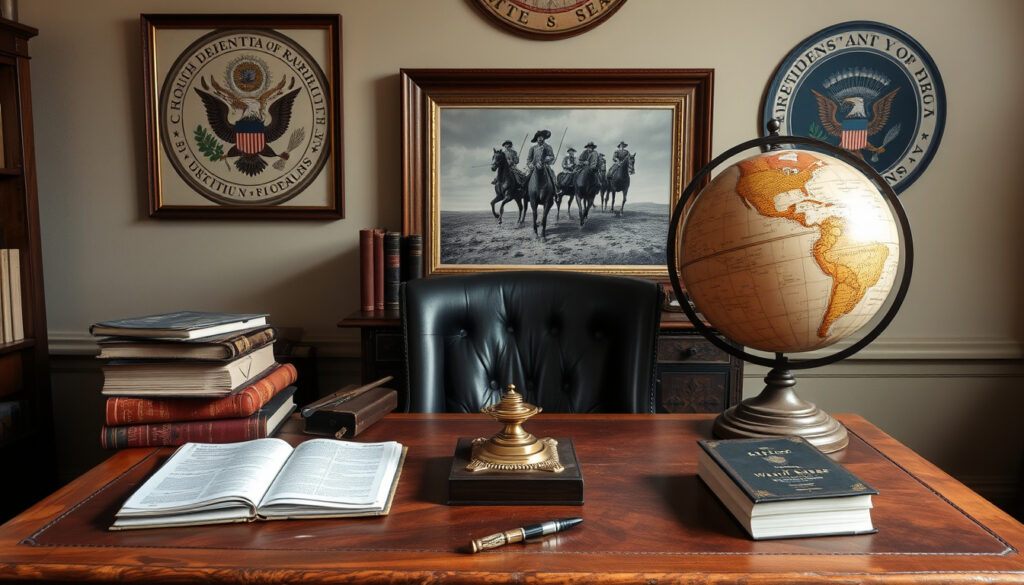
Theodore Roosevelt: Biography, Presidency & Key Facts
Few presidents shaped the office as decisively as Theodore Roosevelt. When a bullet struck his chest in 1912, the 42‑year‑old still managed to deliver a 90‑minute speech—a moment that captured his relentless spirit. This article traces his rise as the youngest president, his progressive Square Deal, and the assassination attempt that nearly ended it all, drawing on official records and historical archives.
Born: October 27, 1858 · Died: January 6, 1919 · Presidential Term: 1901–1909 · Age at Inauguration: 42 years, 322 days · Nobel Peace Prize: 1906 · Political Party: Republican
Quick snapshot
- Roosevelt was 42 when he became president (The White House Archives (official presidential records)).
- He was shot while campaigning in Milwaukee, Wisconsin, on October 14, 1912 (Britannica (historical encyclopedia)).
- He is a fifth cousin of Franklin D. Roosevelt (Wikipedia (collaborative encyclopedia)).
- The exact wording and context of Roosevelt’s statement regarding Jews is debated among historians (National Park Service (US government park service)).
- The precise degree of the cousin relationship between Theodore and Franklin Roosevelt is sometimes reported with slight variations across genealogical sources. (National Park Service (US government park service))
- October 14, 1912 – Survived an assassination attempt in Milwaukee (National Park Service (US government park service)).
- Roosevelt’s conservation legacy remains a foundation for modern environmental policy (White House Historical Association (presidential history nonprofit)).
Seven facts, one pattern: each measure of Roosevelt’s presidency broke ground—from his age at office to his Nobel Prize.
| Label | Value | Source |
|---|---|---|
| Full Name | Theodore Roosevelt Jr. | The White House Archives (official presidential records) |
| Presidency | 26th President (1901–1909) | The White House Archives (official presidential records) |
| Vice President | Charles W. Fairbanks (1905–1909) | Britannica (historical encyclopedia) |
| Preceded by | William McKinley | The White House Archives (official presidential records) |
| Succeeded by | William Howard Taft | The White House Archives (official presidential records) |
| Spouse | Alice Hathaway Lee (m. 1880; died 1884); Edith Kermit Carow (m. 1886) | National Park Service (US government park service) |
| Children | Alice, Theodore III, Kermit, Ethel, Archibald, Quentin | Britannica (historical encyclopedia) |
What is Theodore Roosevelt best known for?
Domestic policies: The Square Deal
- Roosevelt’s Square Deal focused on trust‑busting, consumer protection, and conservation (The White House Archives (official presidential records)).
- He filed antitrust suits under the Sherman Act and forced the dissolution of a major railroad combination (The White House Archives (official presidential records)).
Foreign policy: Big Stick diplomacy and the Panama Canal
- Roosevelt issued the Roosevelt Corollary to the Monroe Doctrine, preventing foreign bases in the Caribbean (The White House Archives (official presidential records)).
- He oversaw the construction of the Panama Canal, which opened on August 15, 1914 (National Park Service (US government park service)).
Conservation and national parks
- Roosevelt established the U.S. Forest Service and protected 230 million acres of public land (White House Historical Association (presidential history nonprofit)).
The pattern: Roosevelt used executive power aggressively on both domestic and foreign fronts—a style that redefined the modern presidency.
Roosevelt’s “Square Deal” gave the federal government a new regulatory role—one that later presidents would expand, for better or worse.
Who was the youngest president in US history?
Roosevelt’s age at inauguration (42)
- At 42 years, 322 days, Theodore Roosevelt became the youngest U.S. president after the assassination of William McKinley on September 14, 1901 (The White House Archives (official presidential records)).
- The minimum age requirement for president is 35 per the U.S. Constitution (Britannica (historical encyclopedia)).
Comparison with other young presidents (JFK, Clinton, Obama)
- John F. Kennedy was the youngest elected president at age 43 (Miller Center (University of Virginia presidential studies)).
- Bill Clinton took office at 46, Barack Obama at 47 (Wikipedia (collaborative encyclopedia)).
What this means: Roosevelt remains the youngest person ever to hold the office, a record that stands more than a century later.
Are Theodore Roosevelt and Franklin Roosevelt related?
Family tree: Fifth cousins
- Theodore Roosevelt and Franklin D. Roosevelt were fifth cousins once removed (Wikipedia (Roosevelt family article)).
- Both descended from the prominent Roosevelt family of New York (Britannica (historical encyclopedia)).
Eleanor Roosevelt’s relation to both
- Franklin married Theodore’s niece, Eleanor Roosevelt, further intertwining the two branches (White House Historical Association (presidential history nonprofit)).
The trade-off: the close family connection often leads to confusion, but they were distinct political figures with different ideologies.
Why did someone shoot Theodore Roosevelt?
The assassination attempt of 1912
- John Flammang Schrank shot Roosevelt in Milwaukee, Wisconsin, on October 14, 1912 (Britannica (historical encyclopedia)).
- Schrank claimed the ghost of William McKinley told him to kill Roosevelt (National Park Service (US government park service)).
John Schrank’s motive and delusion
- Roosevelt survived because the bullet passed through a thick speech manuscript and his metal glasses case (National Park Service (US government park service)).
The catch: Schrank’s delusion was rooted in the third‑term tradition; he saw Roosevelt’s 1912 campaign as a violation of the unwritten rule.
What did Teddy Roosevelt say after getting shot?
“It takes more than that to kill a bull moose”
- Roosevelt declared, “Friends, I shall ask you to be as quiet as possible. I don’t know whether you fully understand that I have just been shot.” (National Park Service (US government park service))
- He then spoke for approximately 90 minutes with the bullet still lodged in his chest (Britannica (historical encyclopedia)).
The 90‑minute speech he delivered
- His opening line was translated from French as “I have just been shot, but it takes more than that to kill a Bull Moose.” (National Park Service (US government park service))
Why this matters: the event cemented his reputation as a man of unbreakable resolve—a moment that became central to his legend.
Which president fathered a child at 70?
John Tyler and his late‑life children
- John Tyler fathered a child at age 70, making him the oldest president to do so (Wikipedia (John Tyler article)).
- Tyler had 15 children total, the most of any president (Britannica (historical encyclopedia)).
Comparison: Theodore Roosevelt’s children
- Theodore Roosevelt fathered his youngest child, Quentin, at age 39 (National Park Service (US government park service)).
The pattern: Roosevelt’s family life was full and active, but he was far from the record for late‑life fatherhood.
Timeline
- October 27, 1858 – Born in New York City (Britannica (historical encyclopedia))
- September 14, 1901 – Became president upon McKinley’s death (The White House Archives (official presidential records))
- 1901–1909 – Served as 26th President (The White House Archives (official presidential records))
- 1904 – Announced the Roosevelt Corollary (The White House Archives (official presidential records))
- 1906 – Awarded the Nobel Peace Prize (Britannica (historical encyclopedia))
- 1912 – Survived assassination attempt (National Park Service (US government park service))
- January 6, 1919 – Died in Oyster Bay, New York (Britannica (historical encyclopedia))
Roosevelt’s bold use of executive power during the Panamanian revolution set a precedent that later presidents would cite—for both intervention and restraint.
Confirmed facts
- Roosevelt was 42 at inauguration (The White House Archives (official presidential records)).
- He was shot in 1912 (Britannica (historical encyclopedia)).
What’s unclear
- Historians debate the precise wording and context of Roosevelt’s remark about Jews, as quoted excerpts lack full context (National Park Service (US government park service)).
- The exact degree of the cousin relationship between Theodore and Franklin Roosevelt is sometimes reported with slight variations across genealogical sources.
Key quotes
“Friends, I shall ask you to be as quiet as possible. I don’t know whether you fully understand that I have just been shot.”
Theodore Roosevelt, Milwaukee, 1912 (National Park Service)
Roosevelt’s “The Man in the Arena” speech, delivered in France in 1910, is among the most frequently cited presidential orations: “It is not the critic who counts; not the man who points out how the strong man stumbles, or where the doer of deeds could have done them better. The credit belongs to the man who is actually in the arena…” (Britannica (historical encyclopedia))
His foreign policy motto, “Speak softly and carry a big stick; you will go far,” became emblematic of his approach to diplomacy (The White House Archives (official presidential records)).
Roosevelt’s legacy is a double‑edged sword. His aggressive expansion of presidential authority gave the office its modern muscle, but it also planted the seeds for later debates about executive overreach. For modern progressives, the lesson is clear: forceful government can deliver real reform—but its power must be balanced with accountability.
For a detailed look at his life and achievements, see Theodore Roosevelts biography and presidency.
Frequently Asked Questions
What was Theodore Roosevelt’s famous quote?
His best‑known line is “Speak softly and carry a big stick,” but “The Man in the Arena” speech is also widely cited.
Did Theodore Roosevelt have any military service?
Yes, he served as a Rough Rider in the Spanish‑American War, leading a charge at the Battle of San Juan Hill (National Park Service).
What is the “Big Stick” policy?
It refers to Roosevelt’s approach of negotiating peacefully while maintaining a strong military threat, often linked to the Panama Canal.
How many children did Theodore Roosevelt have?
Six: Alice, Theodore III, Kermit, Ethel, Archibald, and Quentin.
Where is Theodore Roosevelt buried?
He is buried at Youngs Memorial Cemetery in Oyster Bay, New York (National Park Service).
What health problems did Roosevelt have?
He suffered from severe asthma as a child and later from complications related to his strenuous lifestyle.
Related reading
More related posts
 Bobby Sands: The 1981 Hunger Strike, Death, and Legacy
 Prince Albert: Victorian Consort vs Modern Monaco Prince
 Billie Piper: Biography, Age, Children, Marriages, and Career
 Pain in Lower Right Abdomen Female: Causes & When to Worry
 Laura Hamilton 2025: Relationship, Career & Biography
 Sue Perkins: Biography, Relationships, Health & Career
 Callum Turner: Biography, Net Worth, Relationships & Movies
 Scott Disick: Net Worth, Kids, Relationship Status & Biography
