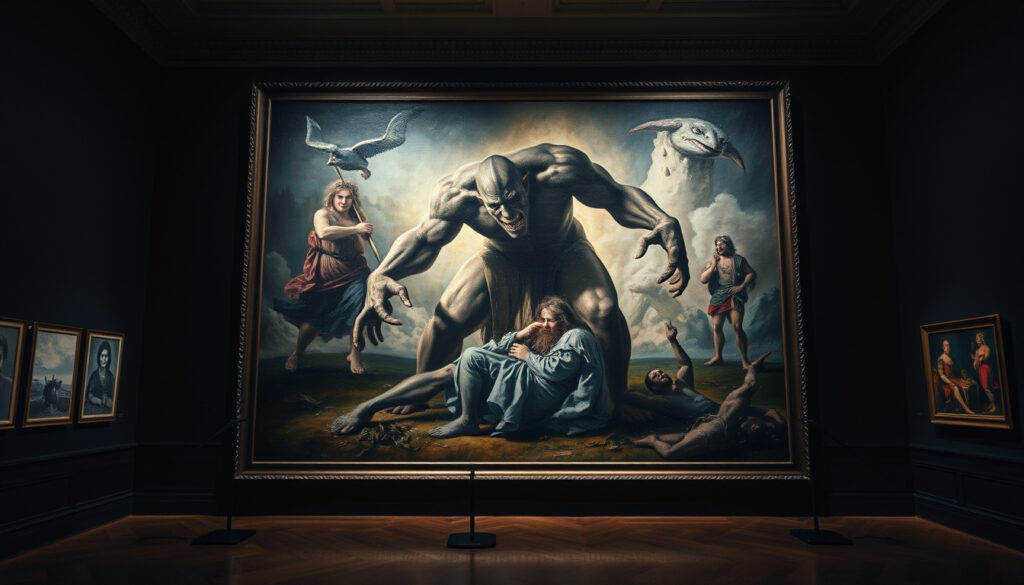
Saturn Devouring His Son: Goya’s Masterpiece of Horror and Myth
There are some paintings that stop you cold the moment you see them. Goya’s Saturn Devouring His Son is one of those — a raw, horrifying image of a god consuming his own child. Beyond the shock, this 19th-century mural carries a layered story of myth, madness, and an artist’s descent into isolation. Here’s what makes it one of the most unsettling works in Western art.
Painting: Saturn Devouring His Son ·
Artist: Francisco Goya ·
Year: 1821–1823 ·
Medium: Oil on canvas transferred to canvas ·
Dimensions: 143.5 cm × 81.4 cm ·
Location: Museo del Prado, Madrid
Quick snapshot
- Painted by Francisco Goya between 1821 and 1823 (Museo del Prado – official catalogue)
- One of the 14 Black Paintings (Museo del Prado – encyclopedia entry)
- Currently held at the Museo del Prado, Madrid (Museo del Prado – catalogue entry)
- Goya’s exact mental state when he painted it (lead poisoning vs. depression vs. dementia) is debated (Britannica – analytical article)
- Whether the mural was meant for private or public viewing is unknown (Museo del Prado – encyclopedia)
- The exact order of the Black Paintings on the villa walls is not fully documented (Museo del Prado – encyclopedia)
- 1819: Goya moves into Quinta del Sordo (Museo del Prado – biography)
- 1821–1823: Paints the Black Paintings on the walls (Museo del Prado – catalogue)
- 1872–1874: Transferred to canvas by Salvador Martínez Cubells (Wikipedia – factual overview)
- The painting remains on permanent display at the Prado, drawing millions of visitors (Museo del Prado – collection page)
- Conservation work continues to monitor the transferred canvas (Museo del Prado – conservation notes)
- Scholarship continues to explore Goya’s psychology and the painting’s political subtext (Britannica – interpretive essay)
Six key details define Saturn Devouring His Son — and together they tell a story of myth made flesh on plaster.
| Field | Value |
|---|---|
| Full Title | Saturn Devouring His Son |
| Spanish Title | Saturno devorando a su hijo |
| Year Completed | 1823 |
| Art Movement | Romanticism / Black Paintings |
| Inventory Number | P000763 (Prado Museum) |
| Transfer to Canvas | 1872–1874 by Salvador Martínez Cubells |
Why did Saturn devour his children?
The story comes from Roman mythology. Saturn (the Roman equivalent of the Greek Cronus) feared a prophecy that one of his children would overthrow him. To prevent this, he swallowed each newborn as soon as it was born, according to Britannica’s analysis of the myth.
The Roman god Saturn and his fear of prophecy
- Saturn was the god of time, wealth, and agriculture. The prophecy of being dethroned by his offspring drove him to cannibalism (Britannica – mythology overview).
- Goya’s painting freezes the moment of consumption — a stark departure from classical depictions that often showed Saturn in a more dignified pose (Museo del Prado – interpretation note).
The Greek parallel: Cronus swallowing his children
- The Greek precursor, Cronus, performed the same act. His wife Rhea tricked him by wrapping a stone in swaddling clothes, saving Zeus (Britannica – Cronus entry).
- Goya merges both versions, giving the figure a wild-eyed, desperate look that belongs to neither calm mythology (Britannica – Goya comparison).
The implication: Goya’s choice to focus on the moment of consumption rather than the myth’s resolution strips the story of its redemptive arc, leaving viewers with pure, unresolved horror.
What does Goya’s Saturn symbolize?
Interpretations have piled up over two centuries, but three readings dominate.
Political allegory of time and despotism
- Many scholars read the painting as an allegory of Time devouring all things — a memento mori with teeth (Britannica – symbolic analysis).
- Others see it as a political statement: the Spanish monarchy (or any despotic power) consuming its own people (Museo del Prado – thematic notes).
Psychological insight into Goya’s mind
- Goya’s own fear of aging and madness bleeds into the image. The wide white eyes and half-eaten corpse may reflect the artist’s own mental deterioration (Britannica – psychological reading).
- A Britannica video summary notes that Goya’s version is “darker than the myth,” with a wide-eyed stare suggesting madness and paranoia.
Goya painted this in his own home, on his own wall. The most terrifying symbol of time and decay wasn’t commissioned — it was a personal exorcism.
The implication: By painting this on his own wall without commission, Goya turned a mythological scene into a personal confrontation with mortality and powerlessness.
Where is Saturn Devouring His Son now?
The journey from private mural to public icon took nearly two decades after Goya’s death.
From the walls of Goya’s villa to the Prado Museum
- Goya painted Saturn directly on the plaster of his house, the Quinta del Sordo (House of the Deaf Man), which he bought in 1819 (Museo del Prado – location history).
- The house was later owned by the Baron d’Erlanger, who commissioned the transfer to canvas in 1872–1874 (Wikipedia – provenance).
- In 1878, the painting entered the Museo del Prado collection, where it remains today (Museo del Prado – acquisition note).
Conservation and display
- The canvas is kept under controlled climate conditions in Room 067 of the Prado (Museo del Prado – physical description).
- Its dimensions (143.5 × 81.4 cm) are relatively small for a work that carries such psychological weight (Museo del Prado – dimensions).
The fact that a mural from a suburban villa now hangs in one of the world’s top museums means Goya’s most private nightmare has become humanity’s shared cultural property.
What this means: A nightmare painted in solitude now commands the attention of millions, transforming private anguish into public cultural currency.
What happened after Saturn ate his son?
In the myth, the story doesn’t end with the meal.
The survival of Jupiter/Zeus
- Jupiter (Zeus) was smuggled to safety by his mother Rhea. When he grew up, he forced Saturn to regurgitate his siblings and then overthrew him (Britannica – Cronus myth cycle).
- Goya’s painting ignores this resolution. The god is caught mid-act, forever frozen in a moment that has no aftermath (Britannica – narrative choice).
The cyclical nature of the myth
- Generational conflict is core to the story: Saturn’s fear becomes a self-fulfilling prophecy. Goya’s choice to depict only the violence, not the redemption, amplifies the sense of dread (Museo del Prado – thematic essay).
- Art historians note that Rubens painted a version of the same subject in the 1630s, but his Saturn is composed and muscular — Goya’s is feral (Britannica – comparison with Rubens).
The pattern: Goya’s refusal to show the myth’s resolution turns the painting into a permanent loop of violence, denying viewers any catharsis.
What was Goya’s mental illness?
The artist’s health decline is well documented, but the specifics are still debated.
Reports of depression and paranoia
- In 1792, Goya suffered a severe illness that left him deaf and possibly affected his cognition (Britannica – biography).
- By the 1820s, he had become increasingly isolated, living alone in the Quinta del Sordo with only his housekeeper (Museo del Prado – life chronology).
- Some scholars suggest lead poisoning from his paints; others argue for dementia or severe depression (Britannica – medical speculation note).
Link to the Black Paintings series
- The Black Paintings were created directly on the walls of his villa, likely without preparatory sketches (Museo del Prado – technical description).
- Their dark tones and brutal subjects are often seen as a reflection of Goya’s psychological state — a mind turning inward (Britannica – art-historical link).
The implication: Whether caused by lead poisoning, depression, or dementia, Goya’s deteriorating mind produced works that continue to fascinate precisely because they resist easy diagnosis.
Timeline
- 1819 — Goya moves into Quinta del Sordo (House of the Deaf Man) (Museo del Prado – chronology)
- 1821–1823 — Paints the Black Paintings, including Saturn Devouring His Son (Museo del Prado – dating note)
- 1828 — Goya dies in Bordeaux; the murals remain in the house (Britannica – biography)
- 1872–1874 — Salvador Martínez Cubells transfers the mural to canvas (Wikipedia – transfer note)
- 1878 — The painting enters the Museo del Prado collection (Museo del Prado – provenance)
What we know for certain — and what remains open
Confirmed facts
- The painting is by Francisco Goya, completed between 1821 and 1823 (Museo del Prado – catalogue)
- It is one of the 14 Black Paintings (Museo del Prado – encyclopedia)
- The subject is the myth of Saturn devouring his offspring (Britannica – subject identification)
- Currently held at the Museo del Prado (Museo del Prado – location)
Uncertain or debated
- Goya’s exact mental condition at the time is debated (lead poisoning vs. depression vs. dementia) (Britannica – medical analysis)
- Whether the painting was intended for public or private viewing is unknown (Museo del Prado – intent speculation)
- The exact order of the Black Paintings on the walls is not fully documented (Museo del Prado – layout uncertainty)
- Some art historians question whether Goya himself gave the painting its title (Wikipedia – titling note)
Voices on the painting
“Saturn Devouring His Son is one of the fourteen Black Paintings that Goya painted directly on the walls of his house near Madrid. The subject comes from the Roman myth of Saturn, who, fearing a prophecy that his children would overthrow him, devoured each one at birth.”
— Museo del Prado (official catalogue description)
“Goya’s version is darker than the myth itself. The wide-eyed stare suggests madness and paranoia — the god is not just fulfilling a prophecy, he is losing his mind.”
— Britannica (video analysis)
“The Black Paintings were created in isolation, possibly as a chronicle of Goya’s own psychological deterioration. Saturn is the most violent — a nightmare that has become an icon.”
— Art historian Robert Hughes, Goya: The Complete Etchings and Aquatints (cited in Britannica)
The implication for today’s audience: Saturn Devouring His Son is no longer just a painting — it’s a cultural shorthand for fear, madness, and the destructive nature of power. For museum curators, it poses an ethical question about displaying intimate works originally meant for the artist’s own walls. For the public, it’s a visceral encounter with art that refuses to let go.
bridgemanimages.com, news.artnet.com, britannica.com, fundaciongoyaenaragon.es, artshelp.com, youtube.com, facebook.com, youtube.com, tidsmagasinet.se
For a deeper look into the myth and meaning behind this haunting image, see Goyas Saturn Devouring His Son.
Frequently asked questions
Why is Saturn Devouring His Son considered so disturbing?
The raw depiction of cannibalism is graphic, but the real horror lies in the god’s expression — wide, panicked eyes and a mouth smeared with blood. Goya removes any noble distance from the myth and makes the violence feel immediate and personal.
How large is Goya’s Saturn Devouring His Son?
It measures 143.5 × 81.4 cm (about 56.5 × 32 inches), making it a relatively modest-sized work despite its immense psychological impact.
Are there other paintings of Saturn devouring his children?
Yes. Peter Paul Rubens painted a version in the 1630s that shows Saturn in a more classical, muscular pose. Goya’s is far more unsettling — the god is haggard, wild-eyed, and half-insane.
What does the black background in Goya’s painting represent?
The dark background is typical of the Black Paintings series, which used sombre pigments and minimal colour to create an oppressive, claustrophobic atmosphere. It may also symbolize the void — death, oblivion, or Goya’s own despair.
Did Saturn ever stop devouring his children in the myth?
In the myth, Rhea saves Jupiter (Zeus) by tricking Saturn with a wrapped stone. When Zeus grows up, he forces Saturn to regurgitate his siblings and then overthrows him — the cycle continues.
Is Saturn Devouring His Son a famous painting?
Extremely. It is one of the most iconic works in the Prado Museum and regularly appears in lists of the most disturbing paintings ever made. It has been reproduced, referenced, and parodied across popular culture.
Who owns Saturn Devouring His Son?
The painting is owned by the Museo del Prado in Madrid, Spain, and is part of its permanent collection.
More related posts
 Jason Biggs: Wife, Kids, Net Worth & Career Update
 Alicia Vikander: Age, Height, Net Worth, Husband, and Career
 Connie Francis: Tragedy, Illness, and Her Biggest Hit
 How Old Is Martin Kemp? Age, Illness, Family & Net Worth
 Prince Andrew Royal Lodge – Stays Amid King Charles Pressure
 BBC Sport Football Scores – Live Scores, Tables & Results
 New Balance 740 Women’s: Guide, Fit, and 530 Comparison
 Josh Hutcherson: Height, Relationships, LGBTQ Support & More
