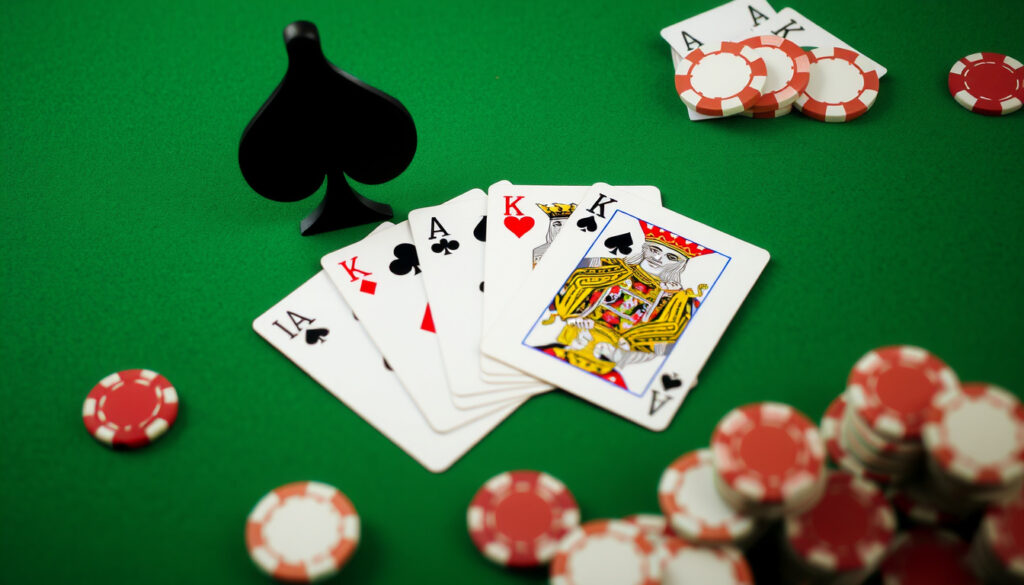
Game of Spades Full House – Rules, Myths and Gameplay Guide
The term “full house” belongs squarely to poker, not to Spades. Players who encounter this phrase while learning Spades often assume it describes a winning hand combination. In reality, Spades operates on an entirely different mechanic—one centered on bidding, trump cards, and winning tricks rather than assembling specific card groupings. Understanding this distinction is the first step toward mastering the game.
Spades is a partnership trick-taking game played with a standard 52-card deck. Four players form two teams, sitting opposite their partners. The objective is straightforward: score points by winning the exact number of tricks you bid at the start of each round. Nothing more, nothing less. The rules governing spades as trump, mandatory bidding, and the scoring structure set Spades apart from poker and every other card game most people know.
What “Full House” Means—and Why It Does Not Apply to Spades
In poker, a full house refers to a hand containing three cards of one rank and two cards of another rank—for example, three Kings and two Sevens. It is one of the stronger hands in the standard poker ranking hierarchy, sitting just below four-of-a-kind and above a flush. The combination requires specific card groupings to score.
Spades discards this entire framework. There are no hand rankings, no combinations to chase, and no concept of assembling a set group of cards. Every player receives 13 cards regardless, and the outcome of each round depends entirely on how many tricks each player wins relative to their bid. The card values matter only within the context of a single trick, not across a complete hand.
Players switching from poker to Spades frequently search for “full house” because they expect a comparable winning hand structure. Spades does not offer one. The game’s depth comes from bidding accuracy, partnership coordination, and tactical trick play instead.
How Spades Works: The Core Mechanics
Setup and the Deal
Each player receives exactly 13 cards, dealt one at a time in clockwise order beginning with the player to the dealer’s left. The opening dealer is selected by drawing cards, with the highest card taking the position. From that point onward, the deal rotates clockwise around the table. The player to the dealer’s right retains the option to cut the deck before cards are distributed, a step intended to prevent any perceived stacking.
Card Rankings and the Role of Spades
Spades function as the permanent trump suit in every round. This means a spade of any rank beats every card from every other suit. Within each suit, cards rank from Ace at the top down to Deuce at the bottom. The Ace stands as the single most powerful card outside of trump situations, while the Two carries the lowest value in any suit context.
This trump structure fundamentally shapes every strategic decision in the game. Holding spades means holding power, regardless of what suits are led in a given trick.
The Bidding Process
Before the first card is played, each player declares how many tricks they expect to win. Bidding begins with the player to the dealer’s left and proceeds clockwise around the table. Several rules govern this phase.
- Every player must bid. Passing is not permitted under standard rules.
- Bids can range from zero to 13, with zero referred to specifically as “nil.”
- Bids do not need to climb sequentially as they do in some other trick-taking games.
- Once a bid is spoken, it cannot be revised for any reason.
A successful nil bid rewards the player with 50 points. Partners combine their individual bids to determine how many tricks their team must win collectively to score positively. This shared target creates the partnership dynamic at the heart of Spades strategy.
Playing a Trick and Following Suit
The player to the dealer’s left opens the first trick by leading any card from their hand. Every other player must follow suit if they hold a card from the suit that was led. When unable to follow suit, a player may play any card from their hand—including a spade, even before the spade-breaking rule has been satisfied.
A trick is won by the highest spade played if any spades appear in that round. If no spades were played, the highest card of the led suit wins instead. The player who captures the trick leads the next one, and play continues until all 13 cards have been played.
The Spade-Breaking Rule
Spades cannot be led as the opening card of a trick until either a spade has already been played on a previous trick or the leader holds nothing but spades remaining in their hand. This restriction prevents early-round spade domination and forces players to use other suits strategically. Some casual games modify or relax this rule to speed up play.
Counting how many spades have already been played is one of the most reliable ways to gauge whether powerful trumps like the Ace or King of spades remain in play. This information directly influences when to play your own high spades.
Scoring and What Determines Success
Points in Spades attach directly to the relationship between what a player bids and what they actually won. Meeting a bid yields 10 points multiplied by the bid amount, plus one additional point for every trick taken beyond the bid—these excess tricks are colloquially called “sandbags.” Falling short of a bid costs 10 points for each trick missed, with no offset from tricks won above the bid.
Nil bidding carries its own separate risk-reward calculation. A player who successfully completes a nil bid earns 50 points for their team. Failing a nil bid—meaning the player accidentally wins at least one trick—costs 10 points per trick taken. Advanced variants recognize “double nil,” worth 200 points when accomplished and carrying proportionally steeper penalties when failed.
The game concludes when at least one team accumulates 500 points. Teams that reach this total first win the match.
Strategic Considerations Worth Knowing
While comprehensive strategy guides remain limited in publicly available sources, several tactical principles emerge clearly from the rules themselves.
- Conservative bidding reduces exposure to penalties when hands are weak or unpredictable.
- Nil bids deliver the highest point swings—use them only when holding a genuinely weak hand.
- Controlling the flow of spades prevents opponents from weaponizing their trump cards unexpectedly.
- Bidding communicates hand strength to your partner without requiring any verbal coordination.
- Accurate trick counting throughout the round verifies whether bids will be met before the final cards fall.
The partnership element distinguishes Spades from most solo trick-taking games. Partners assess each other’s bids to infer hand composition, then adjust their own play to support team objectives—covering weaknesses or maximizing tricks where opportunities arise.
Comparing Poker and Spades Terminology
Poker and Spades share a card deck and basic ranking knowledge, but their gameplay logic diverges sharply. Poker rewards assembled combinations; Spades rewards precise prediction and execution. A poker player learning Spades must unlearn the habit of chasing card groupings and instead focus on bid accuracy and trick flow.
Terms like “full house,” “flush,” and “straight” have no equivalent in Spades terminology. The vocabulary that matters here centers on bids, tricks, sandbags, nil, and spade-breaking. Familiarity with poker terminology provides no advantage at the Spades table.
Do not expect Spades to reward any specific card grouping. Holding four Aces outside of spades means nothing unless you win the trick in which those Aces are played. Every card’s value is situational and depends entirely on the current trick.
Established Rules and Areas of Variation
The fundamental rules described in this article reflect widely accepted standard Spades play as documented across multiple authoritative sources. These core mechanics—the permanent trump status of spades, mandatory bidding, suit-following requirements, and basic scoring—remain consistent across virtually all rule sets.
Certain elements permit variation depending on house rules or regional traditions. Some groups modify the spade-breaking rule to allow leading spades earlier. Others adjust the bag penalty threshold or introduce house limits on nil bids. Tournament settings tend to enforce stricter standard rules, while casual games often relax enforcement to accommodate mixed skill levels.
What Sources Say About Spades
“Spades is a trick-taking partnership card game played with a standard 52-card deck where the objective is to score points by winning the exact number of tricks you bid.”
— Wikipedia, Spades (card game)
“Spades are always the trump suit and rank higher than all other suits.”
— Bicycle Cards, How to Play Spades
The Bottom Line on Spades and Card Combinations
Spades offers no equivalent to a poker full house or any other named hand combination. The game rewards accurate bidding, controlled trump play, and team coordination over card grouping strategy. Players who understand this distinction can approach Spades with the right expectations and focus their energy on the mechanics that actually determine outcomes. For those interested in team-based card games with depth and partnership dynamics, Spades delivers a distinct experience—one built on tricks and bids rather than assembled hands.
Frequently Asked Questions
Can you get a full house in Spades?
No. Spades does not use poker-style hand rankings. There is no combination of cards that qualifies as a full house or any comparable named hand. Success depends entirely on winning the number of tricks bid.
How many cards does each player receive in Spades?
Each player is dealt 13 cards at the start of every round. The entire 52-card deck is distributed across the four players.
When can spades be led in a trick?
Spades cannot be led until either a spade has already been played during a previous trick or the player leading has only spades remaining in their hand.
What happens if you fail to meet your bid in Spades?
You lose 10 points for each trick you fall short of your bid. Tricks won above your bid provide only 1 point each through the sandbag system.
What is a nil bid in Spades?
A nil bid means committing to win zero tricks. Successfully completing a nil scores 50 points, but winning even one trick during that round fails the bid and costs 10 points per trick taken.
How many points are needed to win a game of Spades?
Most standard games end when a team reaches 500 points. The first team to hit or exceed that total wins the match.
What is the strongest card in Spades?
The Ace of spades holds the highest value in the game. Any spade outranks every card from other suits regardless of rank.
Is Spades always played with four players?
While the standard format pairs four players into two teams, variants exist for two, three, or six players. The most common version, however, uses four players at a full table.
More related posts
 Engelbert Humperdinck: Biography, Age, Wife, and Net Worth
 India vs Pakistan Cricket: Head-to-Head Stats & Records
 Mirra Andreeva’s Handshake Controversy and Rise to No. 5
 Tracy Austin: Career, Family & Son Brandon Holt
 Weather in Blackpool 10 Days: BBC, Met Office & AccuWeather
 Sharon Small: Biography, Career, and Current Projects
 Chad Powers Season 2: Confirmed, Cast, and Release Window
 Michelle Collins: Actress vs Comedian – Biography & Personal Life
