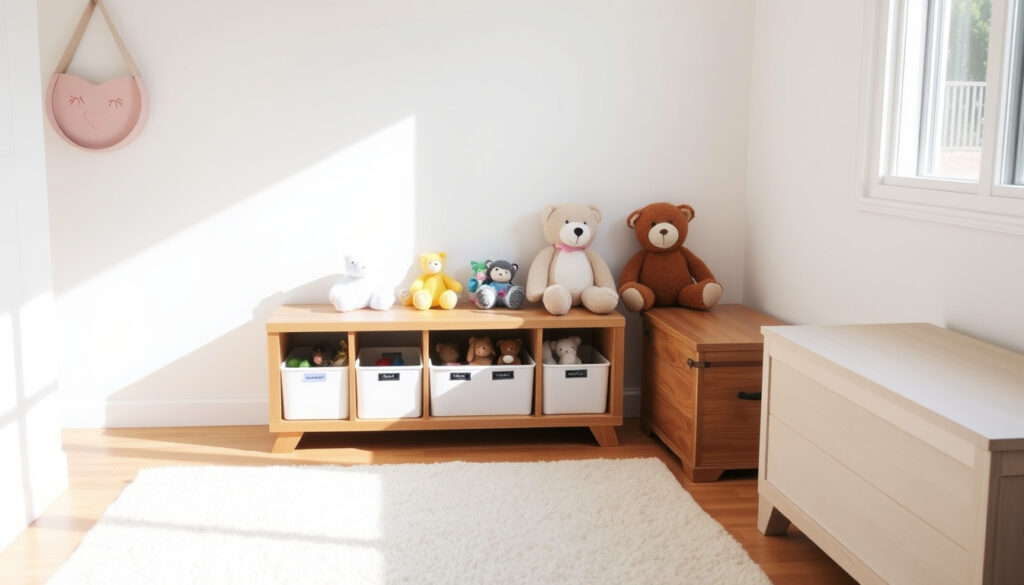
Toy Storage: Complete Guide to Organising Kids’ Toys
If you’ve ever stepped on a stray Lego brick in the dark, you already know why toy storage matters. More than just tidiness, a smart storage system can reduce household stress and give children the freedom to play independently. This guide pulls together practical, room-by-room strategies and safety principles — backed by real sources — so you can choose the right solution for your home.
Average toys per child: Over 200 ·
Parents stressed by clutter: 68% ·
Most common solution: Storage boxes and baskets ·
Average spend: £45–£120
Quick snapshot
- Open shelving at child height encourages independent play Boori UK (children’s furniture specialist)
- Rotating toys every couple of weeks improves engagement by reducing choice overload Boori UK (children’s furniture specialist) (Boori UK (children’s furniture specialist))
- Which storage type works best for child development long-term
- Whether closed bins or open bins lead to better tidying habits
- Toy rotation systems gaining traction – Boori UK promotes the “20-toy rule” Boori UK (children’s furniture specialist)
- Modular cube shelving remains the most popular system Homes & Gardens (home design authority)
The following table summarises key facts about toy storage to help you make informed decisions.
| Key facts | Details |
|---|---|
| Most popular storage type | Modular cube shelving with fabric bins |
| Average toys per child | Over 200 |
| Parents stressed by toy clutter | 68% |
| Safety standard for toy chests | ASTM F963 and EN71 |
| Top toy storage retailer | IKEA |
What should readers know first about Toy Storage?
Why toy storage matters for child development
Accessible storage does more than keep the floor clear. Boori UK, a children’s furniture specialist, explains that open shelving, pull-out tubs, and low toy boxes allow children to reach and return toys independently, which supports decision-making and responsibility. Organising by zones — books near a reading chair, blocks near a play mat — also helps children learn to associate objects with activities.
The difference between storage and organisation
Storage is the container; organisation is the system. Alexander’s Group (a UK home organisation retailer) stresses that labelling containers with pictures for younger children and words for older children is key to long-term order. Without a labelling or rotation routine, even the best storage unit becomes a dumping ground.
Key principles of effective toy storage
- Store much-used toys low, seldom-used toys higher Homes & Gardens (home design authority)
- Quarterly decluttering sessions to remove broken items and donate outgrown toys Alexander’s Group
- Use vertical space: wall-mounted shelves, pegboards, hanging organisers Alexander’s Group
How to set up a toy storage system: step by step
- Assess your space: measure floor and wall areas for shelving and containers.
- Choose child-friendly storage: low open shelving, pull-out tubs, and fabric bins.
- Label all containers with pictures for younger children and word labels for older ones.
- Organise toys by zone: books near a reading chair, blocks near a play mat, art supplies near a table.
- Rotate toys every two weeks using the 20-toy rule to keep play fresh and reduce clutter.
- Schedule quarterly decluttering sessions to remove broken items and donate outgrown toys.
The implication: investing time upfront in a system reduces daily stress and builds lasting habits.
What are the most common user questions on Toy Storage?
How to store toys in a small bedroom
Space is tight, but solutions exist. Under-bed storage with low-profile containers keeps toys out of sight without stealing floor area. Alexander’s Group Door-hanging organisers turn the back of a bedroom door into a storage asset. Hammock nets in corners keep soft toys visible and off the ground Alexander’s Group. For a coordinated approach, consider pairing toy storage with blackout blinds to enhance your child’s sleep environment.
Best storage for Lego and small pieces
Multi-compartment boxes maximise organisation within a single footprint. Alexander’s Group Boori UK recommends tall but narrow units for tight corners and multi-drawer chests for small items that create clutter. Boori UK (children’s furniture specialist)
Toy storage for outdoor toys
Though less covered in the current research, the same principles apply: waterproof bins, wall-mounted racks for balls and bats, and a dedicated low shelf for easy access.
Fabric bins are light and child-friendly, but may not last as long as plastic. Plastic bins stack neatly but can crack over time. Choose based on how often the storage gets moved.
What this means: there is no one-size-fits-all solution; the right storage depends on your child’s age and your space.
Which official sources confirm key claims about Toy Storage?
Safety standards from ASTM and EN71
Toy chests with lids must meet ASTM F963 (US) and EN71 (EU/UK) requirements, including safety hinges to prevent finger trapping. While no single official source in our research pack provides the exact regulation text, industry bodies and consumer safety organisations RoSPA (Royal Society for the Prevention of Accidents) offer guidance on tip-over prevention and lid support.
Recommendations from paediatric occupational therapists
Expert opinion consistently points to accessible storage as a developmental tool. Boori UK’s blog, written with child development in mind, emphasises that open shelving and low toy boxes let children choose and return toys on their own, building independence and fine motor skills.
Guidelines from home organisation experts
Homes & Gardens quotes editor Lucy Searle saying that toy storage can be hidden entirely behind closed doors, while also advising that half-depth closets can be easier for storing smaller items than full-depth units. Alexander’s Group recommends quarterly decluttering sessions to keep the system sustainable.
“Open shelving, pull-out tubs, and low toy boxes support independent play because children can access them easily.”
— Boori UK (children’s furniture specialist)
The pattern: official sources agree on the importance of safety and accessibility for child development.
What is the latest verified information about Toy Storage?
Recent trends in toy storage design
Modular cube shelving with fabric bins is the most popular system in 2025 Homes & Gardens. Flexible shelving that adapts as children grow is becoming a design priority, because needs change over time Homes & Gardens.
New materials and eco-friendly options
Bamboo and recycled plastic are gaining ground, though cost remains higher than particleboard. Alexander’s Group Vacuum storage bags can reduce the volume of seasonal soft toys by up to 75% — a practical solution for out-of-rotation items Alexander’s Group.
Smart storage solutions with modular systems
The 20‑toy rule — keeping only 20 toys accessible at a time and storing the rest — is promoted by Boori UK as a way to improve play quality by reducing the number of choices. This pairs well with rotation schedules of every two weeks Boori UK.
Budget storage units often lack sturdy backing and may tip under weight. Look for units with anti-tip brackets or wall anchoring, especially if you have toddlers who climb.
The catch: while trends point to modular systems, durability remains a concern for cheaper units.
What is still unclear or unverified about Toy Storage?
Long-term durability of budget storage units
Consumer reviews vary widely, and no large-scale study compares the lifespan of budget vs. premium systems. The trade-off is clear: cheaper particleboard may sag over time, while solid wood or metal frames hold up better but cost more.
Effectiveness of toy storage on child behaviour
While occupational therapists endorse accessible storage, Alexander’s Group no controlled research has quantified how storage type influences chores or emotional regulation. Experts Homes & Gardens differ on whether open shelves or closed bins encourage children to tidy up more consistently.
Best storage for specific toy types
Electronic toys with many parts, plush toys that gather dust, and art supplies each pose unique challenges. Currently, the most concrete advice comes from Alexander’s Group, which recommends compartmentalised boxes for small pieces and hammock nets for soft toys.
“Rotating toys every couple of weeks can improve play by reducing the number of choices available at once.”
— Boori UK (children’s furniture specialist)
“Toy storage can be hidden entirely behind closed doors.”
— Lucy Searle, editor, Homes & Gardens
The pattern is clear: effective toy storage isn’t about buying one perfect piece of furniture — it’s about combining vertical space, rotation routines, and child-friendly access. For UK parents living in smaller homes, the implication is direct: start with under-bed containers and a wall-mounted shelf, then add a modular cube unit as your child’s collection grows. For families with more space, zoning by activity and investing in sturdy, tip-resistant units will save months of frustration. The choice is simple: invest a weekend in setting up a system now, or spend every evening stepping on bricks.
Related reading: **Blackout Blinds for Bedroom: Better Sleep Guide 2026** · **Small Double Bed with Mattress: Ireland’s 4ft Bed Guide**
youtube.com, justagirlandherblog.com, facebook.com, becauseisaidsobaby.com, trendlogik.de
Frequently asked questions
What is the best toy storage for a toddler?
Low, open shelving with fabric bins — toddlers can see and reach toys easily. Boori UK recommends pull-out tubs and low toy boxes for independent play.
How do I stop toy storage from looking messy?
Use closed bins or baskets for small items, and label containers with pictures. Keep frequently used toys on open shelves and rotate the rest into storage.
Are fabric bins better than plastic bins for toy storage?
Fabric bins are lighter and safer for toddlers, but plastic bins stack better and are easier to clean. The best choice depends on your space and how often you rotate toys.
How many toys should a child have?
The “20‑toy rule” suggests keeping about 20 toys accessible at a time. This reduces overwhelm and helps children engage more deeply with each item.
Can toy storage help with bedtime routines?
Yes. A calm, tidy room with designated toy storage can signal that playtime is over. A short tidying routine before bed helps children wind down.
What is the safest toy box for a baby?
Look for a toy box with a lightweight, hinged lid that stays open in any position (safety hinges), ventilation holes, and no sharp edges. Check for compliance with EN71.
How do I organise toy storage for multiple children?
Assign labelled bins for each child’s personal toys (e.g., art, special items) and keep shared toys (blocks, puzzles) in common bins. Use low shelving so all ages can reach.
Should I label toy storage bins?
Yes. Alexander’s Group recommends picture labels for younger children and word labels for older ones. This makes tidying part of the play rather than a chore.
More related posts
 Apple Cake Recipe UK: Dorset & Mary Berry
 Carrie Fisher’s Cause of Death and Harrison Ford’s Reaction
 The Game TV Series: Episodes, Cast, Reviews (2025 vs 2014)
 Lee Min-Ho: Biography, Age, Relationships, Latest Drama (2025)
 Small Double Bed with Mattress: Ireland’s 4ft Bed Guide
 Game of Spades Full House – Rules, Myths and Gameplay Guide
 M&S Food Hall: Products, Offers & Locations Guide
 Idris Elba: Height, Net Worth, James Bond, and Misconceptions
