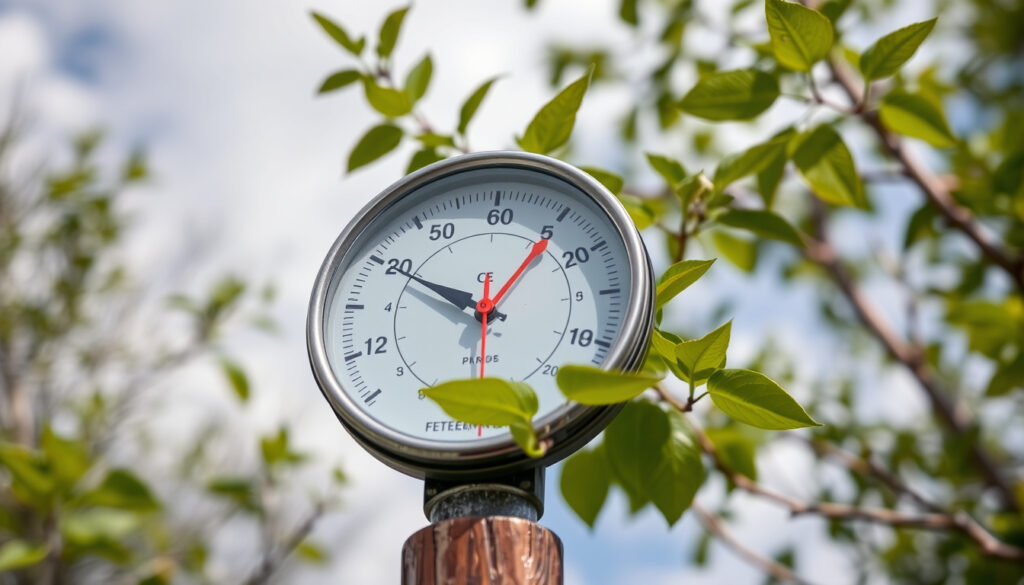
60°F to Celsius: 15.56°C Exact Formula + Hacks
Sixty degrees Fahrenheit sits right in that awkward middle zone where Celsius makes it look colder than it feels — 15.56°C reads as cool, but most travelers need a moment to recalibrate. The math is simple, and a few mental shortcuts can save you from reaching for a calculator every time. By the end of this guide, you’ll know the exact conversion, how to estimate it in your head, and what 60°F actually feels like in real life.
60°F equals: 15.56°C ·
Formula: (°F – 32) × 5/9 ·
70°F equals: 21.11°C ·
Room temp approx: 20-22°C ·
Quick hack: Subtract 30, halve it
Quick snapshot
- 60°F = 15.5556°C exactly (Abakus Europe)
- Formula: (F-32)*5/9 (Abakus Europe)
- Individual comfort varies widely at this temp
- Humidity and wind alter perceived warmth
- Mental shortcut methods published 2012–2015
- Hackaday updated method in 2025
- Apply shortcuts to related temps (70°F, 65°F)
- Match temps to real-life activities
These reference values anchor the conversion math and show how 60°F compares to familiar temperature benchmarks.
| Conversion | Value |
|---|---|
| 60°F to °C | 15.56 |
| Formula | (F – 32) × 5/9 |
| 70°F to °C | 21.11 |
| Boiling point F/C | 212/100 |
How warm is 60 °F in Celsius?
Sixty degrees Fahrenheit converts to 15.5556°C — most sources round this to 15.6°C, but the exact figure is 15.5556°C using the verified formula (60-32)*5/9 = 28*5/9 (Abakus Europe). That puts 60°F squarely in mild spring weather territory, roughly 4°C below what most people consider “room temperature.”
Exact conversion formula
The exact formula to convert Fahrenheit to Celsius is (F – 32) × 5/9 (Abakus Europe). Working through 60°F:
- Subtract 32 from 60 → 28
- Multiply 28 by 5 → 140
- Divide 140 by 9 → 15.5556°C
For reverse conversion, Celsius to Fahrenheit uses C × 9/5 + 32 (Mathnasium UK).
Most recipe sites and cooking resources use (F-32)/1.8, which is mathematically identical to the 5/9 version but involves harder mental division (Tasting Table). Stick with 5/9 for easier arithmetic.
Comparison to common temps
- Freezing point: 32°F = 0°C (God plays dice)
- Room temperature: 68°F = 20°C (God plays dice)
- Body temperature: 98.6°F ≈ 37°C (Abakus Europe)
The pattern holds: every 5°C step in Celsius corresponds to a 9°F jump in Fahrenheit (God plays dice). This ratio (1.8) is why the conversion formula uses 9/5.
The catch: if you’ve memorized “68°F is room temp,” you’ll instinctively feel that 60°F is noticeably cool — about 8°F below comfort zone. But in Celsius terms, 15.56°C sounds closer to comfortable than it feels, which is exactly the gap that frustrates international travelers.
Is 60 Fahrenheit hot or cold?
By most standards, 60°F reads as cool to mild — closer to a crisp autumn morning than summer. Whether it feels “cold” depends heavily on humidity, wind, and what you’re wearing. For someone in a T-shirt at 72°F, 60°F feels cold. For someone layered up at 40°F, 60°F feels warm. The number sits below the human comfort zone range of 68-77°F (20-25°C) (Mathnasium UK), but well above freezing.
Weather perception
At 60°F, most people need a light jacket or sweater outdoors. Indoor spaces without heating often feel cooler than the thermostat reads because radiant heat loss from walls and windows affects perceived temperature. The human comfort zone typically spans 20-25°C (68-77°F) (Mathnasium UK), placing 60°F (15.56°C) below the lower comfort threshold.
Body feel factors
Humidity plays a subtle but real role. Low humidity makes 60°F feel cooler than it is (evaporative cooling off skin), while high humidity can make it feel slightly more comfortable. Wind chill in outdoor settings amplifies the coolness significantly. These factors aren’t in the math but heavily influence whether 60°F “feels cold.”
What this means: your body’s perception of 60°F is less about the number and more about context. A breezy, low-humidity 60°F day feels noticeably colder than a calm, humid 60°F day — even though the thermometer reads identical.
How do you convert F to C quickly?
The mental math shortcut for Fahrenheit to Celsius is simple: subtract 30, then divide by 2 (Thoughtbot). For 60°F, that’s 60 – 30 = 30, then 30 ÷ 2 = 15°C. The exact value is 15.56°C, so the shortcut gives you an error of only 0.56°C — acceptable for most everyday purposes.
Step-by-step formula
To convert any Fahrenheit temperature to Celsius (Abakus Europe):
- Start with your Fahrenheit reading: F
- Subtract 32: F – 32
- Multiply by 5: (F – 32) × 5
- Divide by 9: (F – 32) × 5 ÷ 9
For 60°F specifically: (60 – 32) × 5 ÷ 9 = 28 × 5 ÷ 9 = 140 ÷ 9 = 15.5556°C.
The formula uses 5/9 (or 0.555…) because the Fahrenheit scale spans 180 degrees between freezing and boiling of water, while Celsius spans only 100 degrees. That 1.8 ratio is the key to all conversions (Hackaday).
Mental math hacks
The subtract-30-halve method works because 30 and 2 are round numbers approximating the 32 and 1.8 factors (Thoughtbot). It’s not perfect, but it’s fast:
- 86°F – 32 = 54, 54 × 5/9 = 30°C exact; shortcut gives 86 – 30 = 56 ÷ 2 = 28°C (YouTube Mental Math F to C)
- The shortcut is exactly right at 50°F = 10°C (YouTube Mental Math F to C)
- Errors accumulate about 2°F per 1°C deviation from that sweet spot (God plays dice)
The pattern: approximations work best in the 0-100°F weather range (God plays dice), where most people actually need these conversions. For cooking or scientific use, stick with the exact formula.
How warm is 70 Fahrenheit in Celsius?
Seventy degrees Fahrenheit converts to 21.11°C, placing it firmly in comfortable room-temperature territory. If 60°F is cool autumn air, 70°F is mild spring or a well-heated living room. For those Fahrenheit, 70°F often marks the threshold where most people shed jackets and light sweaters indoors.
70°F conversion
Using the exact formula: (70 – 32) × 5/9 = 38 × 5/9 = 190/9 = 21.11°C (Abakus Europe). The shortcut gives (70 – 30) ÷ 2 = 20°C, just 1.11°C low — good enough for weather, not for science.
Related temps like 65°F, 75°F
- 65°F: exact = 18.33°C, shortcut = 17.5°C
- 75°F: exact = 23.89°C, shortcut = 22.5°C
- 80°F: exact = 26.67°C, shortcut = 25°C
The implication: the shortcut stays within 1.5°C of exact across this range, which is fine for describing “is it warm enough for shorts?” but not precise enough for medical or industrial applications.
Is 60 F too cold to sleep?
Sleep scientists recommend bedroom temperatures between 60-67°F for optimal rest (Abakus Europe), which means 60°F sits right at the recommended floor. For most adults, a bedroom at 60°F is cool but comfortable with appropriate bedding. Whether it feels “too cold” depends on personal factors like sheets, pajamas, and whether you tend to run hot or cold.
Ideal sleep temps
The 60-67°F range exists because cooler bedrooms promote deeper sleep by lowering core body temperature during the night. Above 67°F, many people sleep more restlessly. Below 60°F, cold discomfort can also disrupt sleep — the goal is finding your personal sweet spot within that range.
Personal factors
Thickness of blankets, mattress type, and personal circulation affect whether 60°F feels comfortable at night. Someone who sleeps in lightweight clothing might feel cold at 60°F; someone with a down comforter might feel perfectly warm. Age also plays a role — older adults often feel colder and prefer the higher end of the range.
What this means: 60°F isn’t universally “too cold” for sleep, but it’s the cool end of the recommended range. If you find yourself shivering at night, bump the thermostat up 3-5°F or add a layer. If you sleep hot, 60°F might be your ideal.
How to convert F to C (step-by-step)
Here’s a clean process for converting any Fahrenheit temperature to Celsius, using the exact formula (Abakus Europe). I’ll walk through 60°F as our example.
Step 1: Take your Fahrenheit temperature (e.g., 60°F).
Step 2: Subtract 32: 60 – 32 = 28.
Step 3: Multiply by 5: 28 × 5 = 140.
Step 4: Divide by 9: 140 ÷ 9 = 15.56°C.
Result: 60°F = 15.56°C.
Mental shortcut (for quick estimates): Subtract 30 from the Fahrenheit temperature, then divide by 2. For 60°F: 60 – 30 = 30, 30 ÷ 2 = 15°C (Thoughtbot). This gives 15°C vs the exact 15.56°C — close enough for weather talk.
Verify your shortcut: Take the Celsius result, double it, and add 30. For 15°C: 15 × 2 = 30, 30 + 30 = 60°F. The original Fahrenheit should match (Mathnasium UK).
The catch: this method uses 2 instead of 1.8 and 30 instead of 32, which introduces a small systematic error. At 10°C, the shortcut gives exactly 50°F. But at 20°C, it overshoots to 70°F instead of the exact 68°F (God plays dice). Errors grow about 2°F for every 1°C you move away from that sweet spot.
For weather comparisons, the subtract-30-halve shortcut is accurate within 1-2 degrees — fine for deciding what to wear. For anything requiring precision (health, cooking, science), use the full formula (Hackaday).
What experts say
“Most of us can’t multiply by 9/5 in our heads. But 9/5 is very nearly two.”
— Hackaday (Tech News), 2025
“Fahrenheit to Celsius, subtract 30 then divide by 2.”
— Thoughtbot (Tech Blog)
“This is exactly correct at 10 Celsius / 50 Fahrenheit, and is off by one Fahrenheit degree for each five Celsius degrees.”
— God plays dice (Math Enthusiast), 2012
“Take the temperature in Fahrenheit, subtract 30, and then divide the answer by 2.”
— Mathnasium (Math Tutor), 2015
For Celsius-native readers, 60°F is mild spring weather requiring a light layer — a sweater or jacket over a T-shirt. For Fahrenheit users, mental shortcuts like “subtract 30, halve it” give you 15°C within 0.56°C of exact (Thoughtbot). The human comfort zone sits around 20-25°C (68-77°F) (Mathnasium UK), so 15.56°C is noticeably cool. For sleep, 60°F lands at the cool end of the recommended 60-67°F range — comfortable for most with standard bedding, though personal preference matters.
Frequently asked questions
The exact formula is (°F – 32) × 5/9. For 75°F: (75 – 32) × 5/9 = 43 × 5/9 = 23.89°C. The shortcut (75 – 30) ÷ 2 = 22.5°C is within 1.4°C.
Can humans survive 60°C?
No. Human survivable temperatures top out around 55-60°C in dry heat with hydration, but 60°C would be fatal in minutes. You’re likely asking about 60°F (15.56°C), which is mild and safe.
What is a comfortable room temperature in Celsius?
Room temperature is commonly defined as 20°C (68°F) (Abakus Europe). The broader comfort range spans 20-25°C depending on clothing and activity level.
Is 75 F warm?
Yes. Seventy-five degrees Fahrenheit (23.89°C) falls in the comfortable-to-warm range — T-shirt weather indoors or mild summer temperatures outdoors.
Why am I cold when it’s 70 degrees?
Individual variation matters more than you might think. The comfortable range (68-77°F) is wide, and some people naturally run cold. Low humidity, drafts, and metabolic differences all affect perceived temperature.
What is 50 Fahrenheit to Celsius?
Fifty degrees Fahrenheit equals exactly 10°C — this is the sweet spot where the subtract-30-halve shortcut gives a perfect result (YouTube Mental Math F to C).
What is 80 Fahrenheit to Celsius?
Eighty degrees Fahrenheit equals 26.67°C. The shortcut gives (80 – 30) ÷ 2 = 25°C, about 1.67°C low — acceptable for weather, not for precision work.
Related reading: 160 lbs to kg: Exact Conversion + Stones & BMI Guide · 25 Inches in CM: 63.5 cm Exact Converter Chart & Guide
The guide notes how 70°F to Celsius guide equals 21.11°C, a comfortable benchmark for sleep, weather feel, and everyday comparisons near 60°F.
More related posts
 King Combs: Bio, Net Worth, Songs, and Family
 Prince Edward: Duke of Edinburgh, Black Prince & Abdication
 Prescription Glasses: Read Your Rx & Buy Online
 Shubman Gill: Age, Net Worth, Stats, and Relationship Status
 Freema Agyeman: Biography, Age, Ethnicity, and Career Highlights
 Rafael Nadal: diagnosis, family, net worth & life after tennis
 Cobie Smulders: Biography, Cancer, Career, and Personal Life
 Christina Applegate MS: Health, Net Worth & Life Expectancy
