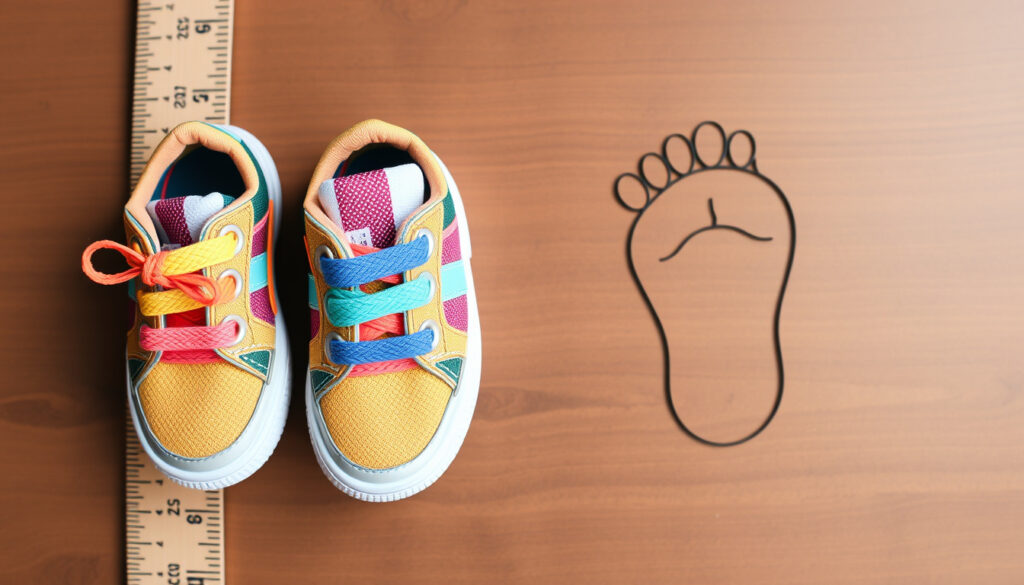
Toddler Shoe Size Chart by Age: Sizes and Fitting Guide
Few things are more frustrating than buying cute toddler shoes that don’t fit. Little feet grow fast, and the age printed on the tag is only a rough guide. This article breaks down the numbers, shows you how to measure like a pro, and explains why a size 12C isn’t the same as a toddler 12.
Average foot length at age 2: 13.5 cm (5.3 inches) ·
US toddler shoe size range: US 4 to US 10 ·
Age-to-size correlation: 2 yrs: US 5-6, 3 yrs: US 7-8, 4 yrs: US 9-10 ·
Foot growth per year: Approximately 1 cm ·
Shoe size change frequency: Every 3–4 months
Quick snapshot
- US sizes for ages 1-4 (use Wearview conversion charts)
- Foot length in cm (Wearview conversion charts)
- Conversion to UK/EU (Wearview conversion charts)
- Step-by-step foot measurement (Kiddie Kobbler St. Laurent fitting guide)
- Best time of day to measure (Kiddie Kobbler St. Laurent fitting guide)
- Tools needed (Kiddie Kobbler St. Laurent fitting guide)
- US to UK (Kids Foot Locker conversion)
- US to EU (Kids Foot Locker conversion)
- UK to EU (Kids Foot Locker conversion)
- Foot length to size (Kids Foot Locker conversion)
- Relying solely on age
- Ignoring width
- Buying too large for growth
- Not re-measuring regularly
Here is a quick reference table summarizing key toddler shoe sizing facts.
| Label | Value |
|---|---|
| Typical toddler age range | 1–4 years |
| US size range for toddlers | 4 to 10 |
| Foot growth per year | ~1 cm |
| Shoe size change frequency | Every 3–4 months |
What are toddler shoe sizes by age?
Toddler shoes cover roughly ages 1 through 4, with US sizes ranging from 4 to 10. The numbers align with foot length, not birthday. A child’s foot grows about 1 cm per year (Wearview).
Typical foot length by age
- 9–12 months: ~11.4 cm (US 4C) – Kidz Global Apparel
- 12–18 months: ~12.1 cm (US 5C) – Nordstrom
- 18–24 months: ~12.7 cm (US 5.5) – Kids Foot Locker size guide
- 2 years: ~13.5 cm (US 5-6) – Wearview
- 3 years: ~15 cm (US 7-8) – Kidz Global Apparel
- 4 years: ~16.5 cm (US 9-10) – Nordstrom
Why this matters: Age is a starting point, but every child grows at their own pace. Foot length measured in centimeters is the only reliable metric for sizing.
US toddler shoe size chart by age
Five common sizes cover the toddler years. Each row pairs a US size with the approximate age range and foot length.
| US Size | UK Size | EU Size | Foot Length (cm) | Approx Age |
|---|---|---|---|---|
| 4C | 3 | 19 | 11.4 | 9–12 months |
| 5C | 4 | 20 | 12.1 | 12–18 months |
| 6C | 5.5 | 22 | 13 | 18–24 months |
| 7C | 6.5 | 23 | 14 | 2 years |
| 8C | 7.5 | 24 | 15 | 2–3 years |
| 9C | 8.5 | 25 | 16 | 3–4 years |
| 10C | 9.5 | 27 | 16.5 | 4 years |
Sources: Kidz Global Apparel, Nordstrom, Kids Foot Locker.
The pattern: Sizes increase by about 0.5–1 cm per half size, and children typically need the next size every 3–4 months.
Age-by-age breakdown: 1, 2, 3, 4 years
- Age 1: US 4–5 (EU 19–20, foot ~11–12 cm)
- Age 2: US 5–6 (EU 20–22, foot ~12–14 cm)
- Age 3: US 7–8 (EU 23–24, foot ~14–15 cm)
- Age 4: US 9–10 (EU 25–27, foot ~15–16.5 cm)
The catch: Active toddlers may size up faster than the averages suggest. Always measure before buying.
The pattern: Age is a starting point, but foot length in centimeters is the only reliable metric.
What size are most 2 year olds’ feet?
Two-year-olds are often in the middle of the toddler sizing range. Their feet have grown steadily since the first birthday.
Average foot length for a 2-year-old
- 13–14 cm (5.1–5.5 inches) – Kids Foot Locker
- US size 5.5 to 6 covers most 2-year-olds
Most 2-year-olds have foot length 13-14 cm. Kids Foot Locker
Most 2-year-olds wear US size 5–6.
Feet grow in spurts, so re-measure every 2–3 months. Kiddie Kobbler St. Laurent
Common shoe sizes for 2-year-olds
- US 5C (UK 4, EU 20) – 12.1 cm, 12–18 months
- US 5.5 (UK 4.5, EU 21) – 12.7 cm, 18–24 months
- US 6C (UK 5.5, EU 22) – 13 cm, 18–24 months – Kidz Global Apparel
- US 6.5 (UK 6, EU 22.5) – 13.5 cm, 2 years
What this means: A 2-year-old wearing US 5 is at the smaller end; one in US 7 is at the taller end. Both are normal.
Variations by growth rate
Children on a rapid growth curve may skip half sizes. Kiddie Kobbler St. Laurent recommends checking for tightness at the toe every month.
The trade-off: Buying shoes that are too big for room to grow can cause stumbling. Aim for a thumb’s width of space (about 1 cm) beyond the longest toe.
For a 2-year-old, US sizes 5 to 6 fit most feet. If your child is in a US 7 already, they may be ahead of the curve — but the real test is length, not age.
The implication: For a 2-year-old, measure rather than rely on age labels.
Is a 4 year old still in toddler shoes?
By age 4, many children outgrow the toddler range and move into little kid (youth) sizes. The tipping point is usually size 10.
Toddler vs little kid shoe categories
- Toddler (C): US 4C–10C, ages 1–4
- Little kid (Y or C above 10): US 10.5–13Y, ages 4–7
- Some brands continue the C labeling up to 13C, but 12C and 13C are officially little kid sizes – Wearview size boundaries
According to Kids Foot Locker, a 4-year-old with foot length 16.5 cm needs US 10C (toddler). Once the foot hits 17 cm, they move to US 10.5 (little kid).
When to transition to youth sizes
- When the child’s foot exceeds the maximum toddler size (US 10C, 16.5 cm)
- When the shoe size says 10.5, 11, 12, 13 (with or without Y or C)
- When the shoe width of toddler sizes becomes too narrow
Signs your child needs bigger shoes
- Heels slipping – Kiddie Kobbler St. Laurent points out this indicates the shoe is too small
- Toes touching the front when standing
- Complaints or tugging at shoes
The implication: Age 4 is the transition zone. Check fit every 2 months; if the child is in US 10C, measure for the next size up in little kid.
Toddler sizes end at US 10C (foot 16.5 cm). A 4-year-old with longer feet needs little kid sizing, but many parents mistakenly buy a 12C thinking it’s still toddler — it’s not.
The catch: The transition from toddler to little kid sizing is not always obvious, so check the fit regularly.
Is a 12c a toddler shoe?
No. Size 12C is a little kid (youth) size, though the “C” can cause confusion.
What does ‘C’ mean in kids’ shoe sizing
- C stands for “Child” — sometimes used for toddler, sometimes for both toddler and little kid
- Most brands use C for sizes 4–10 (toddler) and then Y (youth) for 10.5–13
- Some brands like Crocs use C for all kids sizes up to 13C
According to Kiddie Kobbler St. Laurent, the convention varies. Always check the brand’s specific size chart.
Understanding the 12C size
- 12C foot length: ~18 cm (EU 28–29, UK 11.5)
- It is not toddler — it fits a child around age 5–6
- If your toddler’s foot is 16.5 cm, a 12C would be 1.5 cm too long
Difference between toddler C and little kid sizing
- Toddler C: US 4C–10C, foot 11.4–16.5 cm
- Little kid C (or Y): US 10.5–13C, foot 17–19 cm
- Kids Foot Locker separates the two categories clearly on their size guide
The pattern: The C label persists beyond toddler, but the breakpoint is size 10.5. Anything above 10C is youth.
What is C12 kids size?
The term “C12” appears most often in Crocs sizing, where it means “Child size 12.”
C12 in Crocs sizing
- Crocs uses a simple letter+number system: C12 = US kids size 12 – Crocs size guide
- Corresponds to foot length ~18 cm (EU 29)
- It is a little kid size, not toddler
C12 vs 12C: is there a difference?
- C12 = Crocs-specific notation: the number comes second
- 12C = traditional US shoe size: the number comes first
- Both refer to the same foot length — only the order changes per brand
How to interpret C sizes in different brands
- Nike uses C for toddler up to 10C, then Y for youth – Nike kids footwear size guide
- Clarks uses a separate toddler and little kid chart with specific EU sizes
- Gymboree uses C up to size 13C but categories are clearly marked – Gymboree size charts
Why this matters: When shopping online, always open the brand’s size guide. A 12C from one label might be toddler, from another it’s little kid. Measure the foot and match the cm length, not the age or letter.
How to measure toddler feet correctly
Getting an accurate foot length is the foundation of good fit. Here’s the method recommended by Kiddie Kobbler St. Laurent and other specialists.
- Place a piece of paper on a hard floor against a wall.
- Have the child stand on the paper with heel touching the wall.
- Mark the longest toe.
- Measure from the wall edge to the mark (in cm).
- Repeat for the other foot — they are often different.
- Add 1–1.5 cm (about a thumb’s width) for growth room.
- Use the larger foot measurement and the brand’s size chart to select the best size.
REI’s expert advice adds that measuring at the end of the day (when feet are slightly swollen) gives the most accurate size.
Buying shoes “a size too big” to allow for growth can cause blisters and tripping. A proper fit has a thumb’s width of space — not more.
The pattern: Measuring at the end of the day and adding growth room ensures the best fit.
US, UK, and EU conversion table for toddler shoes
The global toddler shoe market uses three main numbering systems. One pattern: EU sizes rise by 0.67 cm per half size, while US and UK sizes use increments of about 0.3 cm.
| US | UK | EU | Foot Length (cm) | Approx Age |
|---|---|---|---|---|
| 3.5C | 2.5 | 19 | 10.8 | 6–9 months |
| 4C | 3 | 19 | 11.4 | 9–12 months |
| 4.5C | 3.5 | 20 | 11.8 | 12–18 months |
| 5C | 4 | 20 | 12.1 | 12–18 months |
| 5.5C | 4.5 | 21 | 12.7 | 18–24 months |
| 6C | 5.5 | 22 | 13 | 18–24 months |
| 7C | 6.5 | 23 | 14 | 2 years |
| 8C | 7.5 | 24 | 15 | 2–3 years |
| 9C | 8.5 | 25 | 16 | 3–4 years |
| 10C | 9.5 | 27 | 16.5 | 4 years |
Data from Wearview, Kidz Global Apparel, Kids Foot Locker.
The trade-off: US, UK, and EU sizes don’t align perfectly. Always prioritize the centimeter measurement from a brand’s size chart.
What’s clear and what’s not
Confirmed facts
- Measuring foot length is more reliable than age-based charts – Kiddie Kobbler St. Laurent
- Toddler shoe sizes vary by brand – Nike size guide vs Crocs size guide
- US 4C–10C covers the toddler range with foot lengths 11.4–16.5 cm
What’s unclear
- Exact age-to-size mapping is approximate; growth patterns vary widely
- Some brands use different C sizing conventions (e.g., Crocs C12 vs Nike 12C)
- The conversion between US, UK, and EU sizes is not always exact across all brands
What this means: Parents should prioritize foot measurement over brand labeling.
Frequently asked questions
How often should I measure my toddler’s feet?
Every 2–3 months in the first two years, then every 3–4 months after age 2. Feet can grow a full size in a season.
Can I use the same shoe size for different brands?
No. Sizing differs between brands. Always check the brand’s specific size chart and measure foot length in cm.
What does W mean in toddler shoes?
W stands for Wide width. Toddler shoes usually come in Medium (D) or Wide (W). If your child has wider feet, look for the W label.
Are toddler shoe sizes the same in UK and US?
No. UK sizes are typically 1 to 1.5 numbers smaller. For example, US 5C = UK 4.
How to tell if toddler shoes are too tight?
Check for red marks on the feet, the child trying to remove the shoes, or toes curled inside. Measure length regularly.
Should I buy shoes with room for growth?
Yes, leave about a thumb’s width (1 cm) from the longest toe to the shoe end. More than that can cause tripping.
What is the difference between toddler C and youth Y?
Toddler C typically covers US 4–10 (foot up to 16.5 cm). Youth Y starts at 10.5 (foot 17 cm+). Some brands use C through 13C, but sizes above 10 are little kid.
How do I convert toddler shoe sizes from US to EU?
Use the conversion table in this article. EU sizes for toddlers range from 19 to 27, increasing by about 0.67 cm per half size.
For parents shopping for toddler shoes in the US, the decision is clear: measure foot length in centimeters, add 1 cm for growth, ignore the age label. Brands like Nike and Crocs publish precise size guides; use them. Without a centimeter measurement, you’re guessing — and toddler toes don’t have room for guesswork.
More related posts
 Nathan Evans: Sea Shanty Star – Biography, Wife & Net Worth
 Ipswich Town vs Southampton – Preview, H2H and Prediction
 Jutta Leerdam: Olympic Gold Medalist, Net Worth & Jake Paul
 Cameron Monaghan: Biography, Relationships, Movies, and FAQs
 Mare of Easttown Season 2: Winslet Confirms Strong Likelihood
 Apple Cake Recipe UK: Dorset & Mary Berry
 Yung Gravy: Height, Real Name, Girlfriend & More
 Yeti Water Bottle Review: Is It Worth the Price
