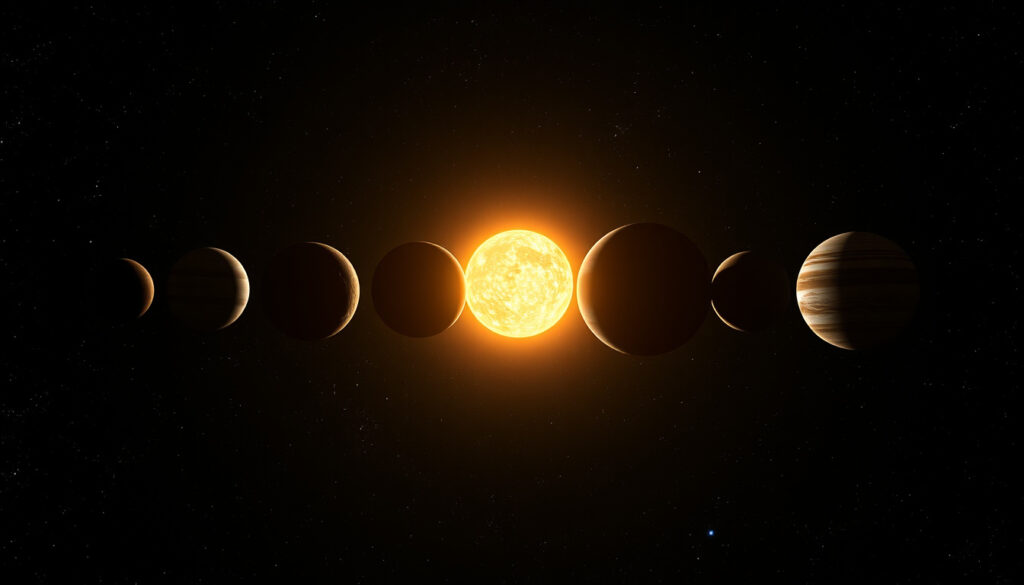
Planets in Our Solar System: 8 Official Worlds in Order
There’s a peculiar thing about knowing something since childhood — you don’t question it until someone else does. Ask most adults how many planets orbit the Sun, and a brief hesitation usually follows. That pause matters because the answer changed in 2006. The International Astronomical Union redefined what makes a planet, and suddenly the solar system had one fewer world. Here’s everything you actually need to know about the eight planets, in order, and why it still matters.
Number of planets: 8 · Largest planet: Jupiter · Planet with rings: Saturn (most prominent) · Former planet: Pluto (now dwarf) · Closest to Sun: Mercury
Quick snapshot
- The solar system officially has eight planets (NASA Science)
- Order from the Sun: Mercury, Venus, Earth, Mars, Jupiter, Saturn, Uranus, Neptune (Space.com)
- Pluto reclassified as a dwarf planet in 2006 by the IAU (NASA Science)
- How many more dwarf planets exist beyond the five recognized (NASA Science)
- The exact composition of deep atmospheres on Uranus and Neptune remains partially unknown (NASA Science)
- 2006: Pluto loses planet status after IAU definition change (NASA Science)
- 2015: NASA’s New Horizons becomes first spacecraft to flyby Pluto (Space.com)
- More Kuiper Belt objects may qualify as dwarf planets as surveys improve
- The IAU recognizes over 100 potential candidates awaiting official designation
Eight worlds orbit the Sun in a well-ordered sequence, each distinct in character and history.
| Attribute | Detail |
|---|---|
| Official count | 8 planets |
| Dwarf examples | Pluto, Ceres, Eris |
| Solar system definition | Sun and orbiting bodies |
What are the 8 planets and describe each in order?
When astronomers list planets in order from the Sun, they begin with Mercury and end with Neptune — eight worlds sorted by their orbital distance. This ordering isn’t arbitrary; it reflects the solar system’s formation history and each planet’s distinct environment.
Mercury
- Closest planet to the Sun
- Smallest of the eight planets
- No substantial atmosphere, extreme temperature swings
Venus
- Second planet from the Sun
- Hottest surface of any planet due to greenhouse effect
- Similar size to Earth, fundamentally different conditions
Earth
- Third planet from the Sun
- Only known world with liquid surface water and life
- Single large natural satellite: the Moon
Mars
- Fourth planet from the Sun
- Called the Red Planet for iron oxide on its surface
- Has two small moons: Phobos and Deimos
Jupiter
- Fifth planet from the Sun
- Largest planet in the solar system
- Gas giant with at least 95 known moons
Saturn
- Sixth planet from the Sun
- Most prominent ring system of any planet
- Second-largest planet with at least 146 known moons
Uranus
- Seventh planet from the Sun
- Tilted axis by roughly 98 degrees, orbiting on its side
- Coldest atmosphere among the gas giants
Neptune
- Eighth and farthest known planet from the Sun
- Strongest sustained winds in the solar system
- Orbital period of approximately 165 Earth years
Why is Pluto no longer a planet?
The question of Pluto’s status cuts deeper than most people expect — it involves a definition fight that split the scientific community and raised fundamental questions about what makes a planet a planet.
In August 2006, the International Astronomical Union established three criteria for full planet status: an object must orbit the Sun, have sufficient mass for gravity to create a nearly round shape, and have cleared the neighborhood around its orbit of other debris.
— International Astronomical Union
IAU definition of planet
Pluto met the first two conditions but failed the third — its orbital zone overlaps with the Kuiper Belt, a region of icy objects beyond Neptune (NASA Science).
Pluto as dwarf planet
The IAU created a new category called “dwarf planets” for objects that meet the first two criteria but have not cleared their orbital neighborhoods. This placed Pluto, along with Eris, Haumea, Makemake, and Ceres, into a separate class. Pluto is smaller than Earth’s Moon and orbits in a region where Neptune’s gravity influences its path (Space.com).
Discovery and naming
Clyde Tombaugh discovered Pluto in 1930 at the Lowell Observatory in Arizona. An 11-year-old girl named Venetia Burney in England suggested the name to her grandfather, who passed it to Lowell Observatory. The name honored the Roman god of the underworld and fit the tradition of naming planets after mythological deities (Space.com).
When Clyde Tombaugh discovered a ninth planet in 1930, the Lowell Observatory received naming suggestions from the public. Venetia Burney, an 11-year-old schoolgirl in England, suggested the name Pluto after the Roman god of the underworld.
— Venetia Burney’s family account
NASA’s New Horizons flyby in 2015 revealed Pluto has mountains made of water ice, nitrogen glaciers, and a hazy nitrogen atmosphere — complexity that surprised scientists and sparked debate about whether the dwarf planet designation fits cleanly.
Why isn’t our Moon considered a planet?
This question trips up many people because the Moon shares key features with planets — it’s large relative to Earth, spherical from its own gravity, and made of rocky material. Yet astronomical classification depends on orbital behavior, not physical characteristics alone.
Planet criteria
A true planet must orbit the Sun directly, not another planet. The Moon fails this criterion because it orbits Earth, which itself orbits the Sun. The Moon is gravitationally bound to Earth and travels with it through space, but follows a path that curves around Earth’s center rather than the Sun’s (Royal Observatory Greenwich).
Moon’s orbit around Earth
The Moon completes one orbit around Earth in approximately 27.3 days, which defines our lunar month. During this orbit, it follows a path controlled primarily by Earth’s gravity. Even though the Moon travels around the Sun as part of the Earth-Moon system, its motion relative to the Sun never creates a direct heliocentric orbit — it never “falls” directly toward the Sun in the way planets do.
Classification matters because it reflects fundamental dynamics: planets dominate their orbital zones while moons operate within a planet’s gravitational sphere. The Moon’s status as a satellite rather than a planet teaches us that size and composition alone don’t determine astronomical category.
What are the dwarf planets in our solar system?
Dwarf planets occupy a middle ground — large enough for gravity to shape them into spheres, but not dominant enough in their orbits to clear away neighboring objects. The IAU officially recognizes five, though the door remains open for more.
Pluto
Pluto remains the most famous dwarf planet, discovered in 1930 and reclassified in 2006. It has five known moons, a nitrogen-methane atmosphere, and a heart-shaped nitrogen ice plain called Sputnik Planitia. Its orbital period spans 248 Earth years, and it crosses Neptune’s orbital path during part of each circuit (Space.com).
Ceres
Ceres sits in the asteroid belt between Mars and Jupiter, making it the only dwarf planet in the inner solar system. NASA’s Dawn mission visited Ceres in 2015, becoming the first spacecraft to orbit a dwarf planet. Ceres is the smallest recognized dwarf planet and was the first asteroid discovered, initially classified as a planet before more asteroids were found nearby.
Eris
Eris orbits in the scattered disc region beyond the Kuiper Belt and was discovered in 2005. It is nearly the same size as Pluto and was actually the trigger for the IAU’s definition debate — its discovery suggested there might be many more large objects waiting to be found, forcing astronomers to decide what “planet” really means.
Others
Haumea and Makemake round out the five recognized dwarf planets. Both orbit in the Kuiper Belt region. Haumea has an elongated shape and at least two moons, while Makemake has one known moon. Astronomers expect more than a hundred candidate objects could eventually qualify as dwarf planets as surveys improve (NASA Science).
Which planet has 42 years?
Uranus completes one orbit around the Sun in roughly 84 Earth years, so one Uranian year spans more than eight decades of human life. The “42 years” reference typically relates to specific orbital positions or observational windows rather than a single orbital period.
Uranus rotation and orbit facts
Uranus rotates on its axis in approximately 17 hours, yet the planet’s extreme axial tilt — roughly 98 degrees from vertical — means that each pole experiences 42 years of continuous sunlight followed by 42 years of darkness. This occurs because Uranus effectively rolls around the Sun on its side. Its atmosphere reaches temperatures of -224 degrees Celsius, making it the coldest planetary atmosphere in the solar system (Space.com).
Uranus remains an enigma — Voyager 2 provided our only close-up data in 1986, and no dedicated mission has followed. Scientists understand its basic composition but debate its internal dynamics, its strange magnetic field, and why it tilted so dramatically in the first place. For a planet with 42-year seasons, we’ve spent remarkably little time looking closely.
Related reading: planets order from the Sun · dwarf planets like Ceres
Frequently asked questions
What are the planets in our solar system in order?
The planets in order from the Sun are Mercury, Venus, Earth, Mars, Jupiter, Saturn, Uranus, and Neptune. This sequence represents orbital distance from closest to farthest.
What is the biggest planet in our solar system?
Jupiter is the largest planet, with a mass more than twice that of all other planets combined. It is classified as a gas giant and has at least 95 known moons.
Which planets in our solar system have rings?
All four giant planets — Jupiter, Saturn, Uranus, and Neptune — have ring systems. Saturn’s rings are the most prominent and visible from Earth, but the others also possess faint rings of ice and rock particles.
What is the solar system?
The solar system consists of the Sun and all objects bound to it by gravity, including the eight planets, dwarf planets, moons, asteroids, comets, and other bodies that orbit our star.
What are the 8 planets?
The eight planets are Mercury, Venus, Earth, Mars, Jupiter, Saturn, Uranus, and Neptune. They are divided into rocky inner planets (Mercury through Mars) and gas or ice giants (Jupiter through Neptune).
How many moons do the eight planets have combined?
The eight planets have over 250 known moons combined, with Jupiter leading at at least 95 and Saturn close behind with at least 146 known moons. The inner planets have few or no moons, while the outer gas and ice giants host extensive moon systems.
Why was Pluto named by an 11-year-old?
When Clyde Tombaugh discovered a ninth planet in 1930, the Lowell Observatory received naming suggestions from the public. Venetia Burney, an 11-year-old schoolgirl in England, suggested the name Pluto after the Roman god of the underworld. Her grandfather passed the suggestion to the observatory, and it was adopted.
What is the Moon’s full name?
The Moon does not have a formal proper name beyond “the Moon” for Earth’s satellite. Its designation in astronomical catalogs is “Luna,” derived from the Latin word for Moon, but this is not an official proper name.
More related posts
 Who is Steve Bracknall? The Viral Sunday League Manager
 Cheryl Tweedy: Net Worth, Relationships, Life After Girls Aloud
 Evangelos Marinakis Net Worth: $2.8B Biography & Clubs
 Brendan Ingle and the Split with Prince Naseem Hamed
 Andrew Scarborough: Actor from Downton Abbey and Emmerdale
 Chris McCausland: Blindness, Wife, Stand-Up Tour & Strictly Facts
 Corey Gamble: Age, Net Worth, Job, and Relationship with Kris Jenner
