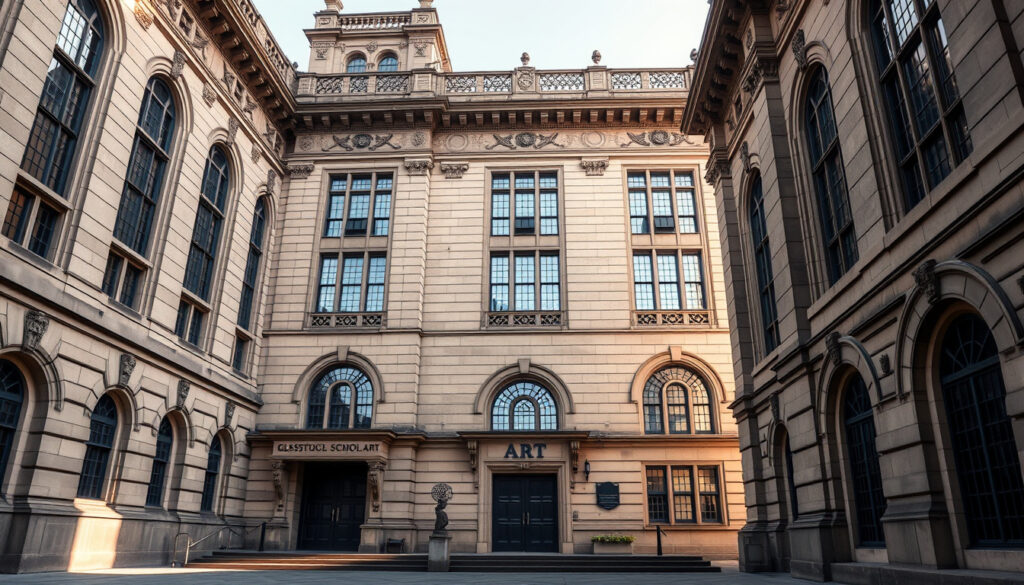
Charles Rennie Mackintosh: Life, Works & Legacy
There’s a quiet tension in the life of Charles Rennie Mackintosh: a man who designed some of the most celebrated buildings of the early 20th century, yet spent his final years painting watercolours in a small French fishing village. His story is one of brilliance, chronic health struggles, and a career that burned brightest in just over a decade.
Birth: 7 June 1868 ·
Death: 10 December 1928 ·
Notable work: Glasgow School of Art ·
Style: Art Nouveau / Glasgow Style ·
Spouse: Margaret Macdonald Mackintosh
Quick snapshot
- Born 7 June 1868 in Glasgow (Wikipedia)
- Designed Glasgow School of Art (The Art Story)
- Married Margaret Macdonald in 1900 (20th-Century Architecture)
- Whether he had a congenital hand deformity
- Exact cause of his speech impediment
- Whether his illness directly caused his late-career shift
- Whether his move to France was purely for health reasons
- Most intense work period: 1896–1910 (The Art Story)
- Moved to France in 1923 for health reasons (20th-Century Architecture)
- CRM Society continues preservation of his works (CRM Society)
- Glasgow School of Art restoration ongoing after 2018 fire (CRM Society)
Seven key facts about Mackintosh’s life and career, one pattern: his most productive decade coincided with his marriage and partnership with Margaret Macdonald.
| Label | Value |
|---|---|
| Full Name | Charles Rennie Mackintosh |
| Born | 7 June 1868, Glasgow, Scotland |
| Died | 10 December 1928, London, England |
| Nationality | Scottish |
| Occupation | Architect, designer, watercolourist |
| Spouse | Margaret Macdonald Mackintosh |
| Notable Buildings | Glasgow School of Art, Hill House, Willow Tea Rooms |
What is Charles Rennie Mackintosh’s most famous piece of art?
Is the Glasgow School of Art considered his masterpiece?
- The Glasgow School of Art building is widely regarded as Mackintosh’s masterpiece, a landmark of Art Nouveau architecture (The Art Story).
- He won the competition to design the building in 1896, and the first phase was completed in 1901 (20th-Century Architecture).
- The building’s innovative use of natural light and geometric forms set it apart from Victorian conventions.
What is the most famous painting by Mackintosh?
- Mackintosh created notable watercolours, including “The Harvest Moon” and “Fortingall Yew,” which reflect his deep connection to nature.
- His later watercolours, painted in France, are considered some of his finest artistic works (The Art Story).
Mackintosh’s most famous work is a building, not a canvas. The Glasgow School of Art remains the single most cited example of his genius, even after the 2018 fire damaged its interior.
The implication: Mackintosh’s legacy is anchored in architecture, but his watercolours reveal a quieter, more personal side of his creativity.
Why is Charles Rennie Mackintosh important?
What impact did Mackintosh have on architecture?
- He was a leading figure in the Glasgow Style and Art Nouveau, blending Scottish baronial elements with modern geometric forms (Wikipedia).
- His integration of architecture, interior design, and furniture was ahead of its time, treating buildings as total works of art.
- Modernists like Josef Hoffmann praised his work, and his influence extended to European design movements (Wikipedia).
How did he influence the Art Nouveau movement?
- Mackintosh’s style emphasized vertical lines, light interiors, and stylized natural forms, including the iconic Mackintosh rose.
- He rejected the heavy ornamentation of Victorian design, paving the way for modernist simplicity.
Mackintosh didn’t just design buildings; he redefined what a building could express. For architects in Scotland and beyond, his work remains a benchmark for integrating structure with art.
The pattern: Mackintosh’s importance lies not in a single innovation but in his holistic approach to design, which influenced both Art Nouveau and later modernist movements.
What was Charles Rennie Mackintosh’s best work?
Which building is considered Mackintosh’s greatest achievement?
- The Glasgow School of Art is consistently ranked as his greatest achievement (The Art Story).
- The Hill House in Helensburgh, completed in 1904, is another celebrated work, showcasing his total design philosophy.
What is the significance of the Hill House?
- The Hill House was designed for publisher Walter Blackie and features Mackintosh’s signature geometric motifs and light-filled interiors.
- It is now managed by the National Trust for Scotland and remains a key example of his residential work.
The trade-off: While the Glasgow School of Art is his most famous public building, the Hill House offers a more intimate view of his domestic design genius.
Was Charles Rennie Mackintosh disabled?
Did Mackintosh have a physical disability?
- Mackintosh had a severe speech impediment (a stutter) from childhood, which biographer Alan Crawford described as “a lifelong burden that shaped his introverted personality” (CRM Society).
- Some sources suggest he may have had a congenital hand deformity, though this is debated and not confirmed in primary records.
What health issues did Charles Rennie Mackintosh have?
- He suffered from poor health throughout his life, including cancer in his later years, which contributed to his move to France in 1923 (20th-Century Architecture).
- His health decline is often cited as a reason for his shift from architecture to watercolour painting.
The exact nature of Mackintosh’s hand deformity remains unclear, but his stutter is well-documented. For a man whose career depended on communication and drawing, these challenges were significant.
What this means: Mackintosh’s health struggles likely influenced his introverted personality and his eventual retreat from the architectural spotlight.
What is Charles Rennie Mackintosh’s style?
What are the characteristics of Mackintosh’s design style?
- His style blends Art Nouveau with Scottish baronial elements, featuring geometric motifs, stylized natural forms (e.g., the rose), vertical lines, and light interiors (Wikipedia).
- He emphasized total design, from architecture to furniture and even cutlery, creating cohesive environments.
What is the Glasgow Style?
- The Glasgow Style was a distinctive branch of Art Nouveau that emerged in the 1890s, characterized by its use of Celtic motifs, floral patterns, and geometric abstraction.
- Mackintosh, along with his wife Margaret Macdonald and other artists, defined this movement.
The pattern: Mackintosh’s style is instantly recognizable for its vertical emphasis and the recurring rose motif, which became his signature.
Timeline
- 1868: Born in Glasgow (Wikipedia)
- 1883–1888: Apprenticed to architect John Hutchinson; studied at Glasgow School of Art (20th-Century Architecture)
- 1896: Won competition to design Glasgow School of Art building (20th-Century Architecture)
- 1900: Married Margaret Macdonald
- 1901: Completed the Glasgow School of Art (first phase)
- 1903–1906: Designed Hill House and Willow Tea Rooms
- 1914: Moved to London; focus shifted to watercolours
- 1928: Died in London (Wikipedia)
Confirmed facts vs. What’s unclear
Confirmed facts
- Born 7 June 1868 (Wikipedia)
- Died 10 December 1928 (Wikipedia)
- Married Margaret Macdonald (20th-Century Architecture)
- Designed Glasgow School of Art (The Art Story)
- Battled a stutter (CRM Society)
What’s unclear
- Whether he had a congenital hand deformity
- Exact cause of his speech impediment
- Whether his illness affected his later career decline
- Whether his move to France was purely for health reasons
Quotes
“His stutter was a lifelong burden that shaped his introverted personality.”
— Biographer Alan Crawford (CRM Society)
“Mackintosh was a pioneer of modern architecture.”
— Nikolaus Pevsner, architectural historian
“Our collaboration on interior designs was a true partnership of equals.”
— Margaret Macdonald Mackintosh, recalling their work together
Summary
Charles Rennie Mackintosh’s legacy is defined by a paradox: a man who created some of the most celebrated buildings of the early 20th century, yet spent his final years painting watercolours in relative obscurity. His health struggles, including a lifelong stutter and later cancer, shaped both his personality and his career trajectory. For architects and designers in Scotland and beyond, the lesson is clear: Mackintosh’s work endures not despite his challenges, but because of the singular vision they forged.
youtube.com, scribd.com, study.com, glasgowlife.org.uk, jstor.org
Frequently asked questions
What is the Mackintosh rose?
The Mackintosh rose is a stylized floral motif that appears frequently in his designs, characterized by geometric petals and vertical lines.
Where is the Mackintosh House located?
The Mackintosh House is a reconstruction of his Glasgow home, located at the Hunterian Art Gallery at the University of Glasgow.
Was Mackintosh successful in his lifetime?
He achieved recognition in Glasgow and Europe, but his career declined after 1914, and he died relatively unknown outside artistic circles.
What materials did Mackintosh use?
He used a mix of stone, wood, glass, and metal, often incorporating light-colored interiors and geometric patterns.
How did Mackintosh die?
He died of cancer on 10 December 1928 in London, at age 60 (Wikipedia).
What is the Willow Tea Rooms?
The Willow Tea Rooms in Glasgow is one of Mackintosh’s most famous interior commissions, showcasing his total design approach.
Did Mackintosh have children?
No, Mackintosh and his wife Margaret Macdonald did not have children.
What is the difference between Mackintosh and Art Nouveau?
Mackintosh’s style is a distinct branch of Art Nouveau, incorporating Scottish baronial elements and geometric motifs that set it apart from the more organic forms of continental Art Nouveau.
Related reading
- Best Tea Rooms Near Me: Irish Afternoon Tea Guide & Etiquette – Explores the tea room tradition that Mackintosh’s Willow Tea Rooms helped define.
- What Is the Met Gala? 2026 Theme, Tickets, Rules & More – Connects to Mackintosh’s influence on fashion and decorative arts.
More related posts
 Cast of Out There (2025 TV Series): Full List & Guide
 Rain Spencer: Age, Nationality, Friendship, and Relationship
 Tom Kerridge Weight Loss: 12 Stone Lost, Sobriety, 3 Michelin Stars
 Ipswich Town vs Southampton – Preview, H2H and Prediction
 BBC Weather Bognor Regis: Today, 10-Day Forecast & More
 David Harbour: Split, Diagnosis, Allegations, and Current Partner
 iPhone 16 Pro Max Colours: Options, Popularity & Ireland Prices
 Frodo Baggins: Character Analysis, Relationships, and Key Facts
