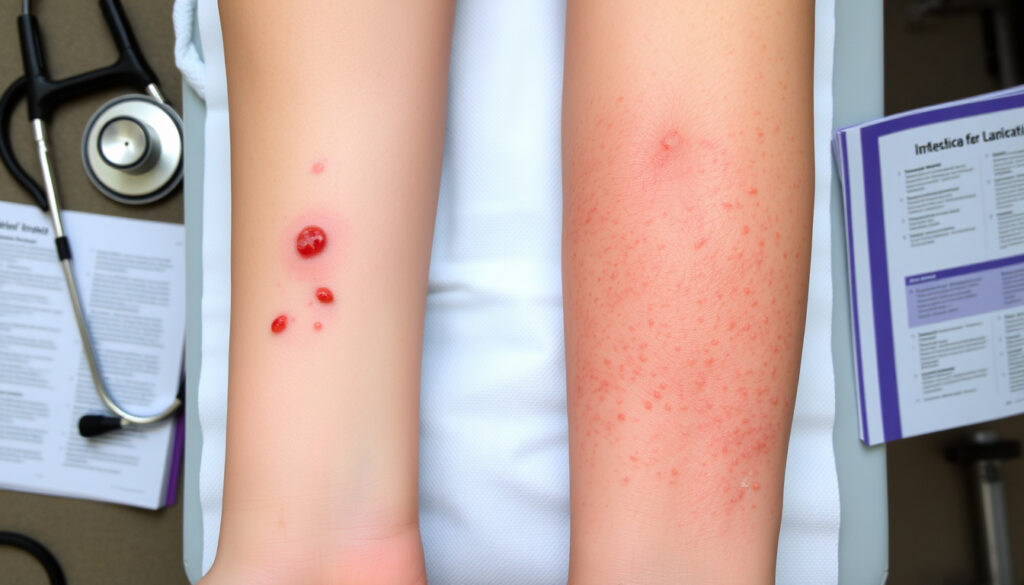
Heat Rash vs Allergic Reaction: How to Tell the Difference
It can be alarming when your skin suddenly breaks out in red bumps after a hot day or a workout. This guide uses expert sources to help you tell apart heat rash, cholinergic urticaria, and allergic reactions by their triggers, appearance, and timing.
Heat rash duration: 2–3 days (NHS (UK health authority)) ·
Cholinergic urticaria onset: Within minutes of body temperature rise (Cleveland Clinic (physician-led medical centre)) ·
Allergic reaction symptoms: Hives, swelling, itching; anaphylaxis possible (HSE (Irish public health service)) ·
Heat rash prevalence: Up to 30% of adults in hot, humid conditions (DermNet (dermatology reference))
Quick snapshot
- Heat rash is caused by blocked sweat ducts (NHS)
- Cholinergic urticaria is triggered by rising body temperature (Cleveland Clinic)
- Allergic reactions involve histamine release and can be life-threatening (Mayo Clinic (medical research institution))
- Why some people develop cholinergic urticaria later in life without prior history (WebMD (consumer health publisher))
- The exact mechanism behind the “3‑day rule” for allergy rashes (HSE)
- The exact cause of cholinergic urticaria remains unclear (Cleveland Clinic)
- Heat hives (cholinergic urticaria) usually appear within minutes and subside in 1–2 hours (Healthline (medical news publisher))
- Heat rash from blocked ducts lasts 2–3 days with cooling (NHS) (Healthline (medical news publisher))
- Acute allergic hives often clear within a day (Mayo Clinic) (Healthline (medical news publisher))
- If hives persist >6 weeks, see a doctor for chronic urticaria (Mayo Clinic)
- Severe allergic reactions require emergency care (WebMD)
Six key differences at a glance — the table below shows how heat rash, cholinergic urticaria, and classic allergic hives compare across cause, appearance, sensation, and duration.
| Condition | Cause | Appearance | Itching | Duration | Treatment |
|---|---|---|---|---|---|
| Heat rash (miliaria) | Blocked sweat ducts | Small red bumps or blisters in skin folds | Mild stinging / prickling | 2–3 days | Cooling, calamine lotion |
| Allergic reaction (hives/urticaria) | Histamine release from allergen | Raised, red or skin-coloured welts, variable size | Intensely itchy, may burn | Hours to days (acute) – can become chronic (>6 weeks) | Antihistamines, epinephrine if severe |
| Cholinergic urticaria (heat hives) | Rise in body temperature (exercise, heat, stress) | Tiny pinpoint hives surrounded by red skin | Intense itching | Minutes to ~2 hours | Cooling, antihistamines; sometimes medicated creams |
How do I know if I have a heat rash or an allergic reaction?
The key distinction: heat rash appears in sweat-prone areas and lasts days, while cholinergic urticaria occurs within minutes of exercise and fades in an hour. Allergic hives can appear anywhere and come with intense itching.
Visual differences: heat rash vs. hives
- Heat rash appears as small red bumps or tiny blisters, often in clusters on the neck, chest, or groin — anywhere sweat gets trapped. (NHS)
- Allergic hives are raised, red or skin‑coloured welts that can merge into large blotches. They can appear suddenly anywhere on the body. (WebMD)
- Cholinergic urticaria produces tiny hives (1–3 mm) surrounded by a red flare — often on the upper body and arms. (WebMD)
Itching vs. stinging sensation
Heat rash is typically described as prickly or stinging — hence the name “prickly heat.” Allergic hives are almost always intensely itchy, sometimes with a burning sensation. Cholinergic urticaria also itches severely, but the rash fades much faster once you cool down. (Healthline)
Body distribution and timing
Heat rash stays where sweat is trapped — under clothing, in skin folds, on the back. Hives and cholinergic urticaria can spread widely. The timing is also a clue: heat hives appear within minutes of starting to sweat and vanish within an hour or two, while heat rash takes hours of heat exposure to develop and lasts days. (Mayo Clinic)
Why this matters: If your rash comes on fast while you’re active and fades quickly when you rest, cholinergic urticaria is the likely culprit. If it sticks around for two days, think heat rash. If it’s welts that come and go without any clear heat trigger, suspect an allergic reaction.
What triggers a heat rash?
Blocked sweat glands
Heat rash, medically called miliaria, happens when sweat ducts become clogged. Sweat builds up under the skin, causing inflammation and the characteristic bumps. Infants and people who are overweight or inactive are more prone because their skin folds trap moisture. (NHS)
Environmental factors: heat, humidity, tight clothing
- Hot, humid weather is the top trigger — up to 30% of adults in such conditions develop heat rash. (DermNet)
- Wearing synthetic, tight clothing that doesn’t allow sweat to evaporate makes it worse.
- Prolonged bed rest or fever that causes sweating can also trigger it.
Who is most at risk
Infants, the elderly, people who are bedridden, and anyone living in tropical climates are most affected. Adults who exercise in hot environments or sleep under heavy blankets in summer are also vulnerable. (NHS)
The catch: Heat rash is easy to prevent — keep cool, wear loose cotton clothing, and shower after sweating. But if you keep breaking out despite those measures, you might be dealing with cholinergic urticaria rather than blocked ducts.
Why am I suddenly allergic to heat?
Cholinergic urticaria explained
Cholinergic urticaria is a form of physical urticaria — a hive reaction caused by physical stimuli rather than an external allergen. In this case, the trigger is a rise in core body temperature. It can hit within minutes of starting to exercise, taking a hot shower, or even feeling stressed or embarrassed. (Cleveland Clinic)
Difference between heat rash and heat allergy
Some people call cholinergic urticaria “heat allergy,” but it’s not a true allergy — it’s an overreaction of the nervous system. The hives are small and appear along with sweating. Heat rash, by contrast, is a mechanical blockage, not an immune response. The key difference: heat hives resolve fast and come back every time you heat up; heat rash lingers but doesn’t return instantly. (Healthline)
Possible underlying causes
The exact cause remains unclear. It may involve an autoimmune‑like response where the body attacks its own sweat gland cells, releasing histamine. Some people develop it later in life without a prior history. Stress and anxiety can also bring on attacks. (WebMD)
The trade-off: If you’re suddenly getting hives every time you warm up, you can still exercise — you just need to anticipate the rash. Many people manage it by cooling down slowly and using antihistamines before activity.
What could be mistaken for heat rash?
Contact dermatitis
Rashes from fabrics, laundry detergents, or lotions can mimic heat rash. Contact dermatitis usually appears where the irritant touched the skin — the same areas as heat rash (arms, torso). But it tends to be more persistently itchy and may include dry, cracked skin. (Mayo Clinic)
Sun rash (polymorphic light eruption)
Sun rash shows up on sun‑exposed areas like the arms, chest, and face — not under clothing. It causes red, itchy patches and small bumps that resemble heat rash. The trigger is UV exposure, not heat or sweat. (DermNet)
Fungal or bacterial infections
Folliculitis (inflamed hair follicles) can look like heat rash with red bumps around hair roots. It often appears after shaving or wearing tight clothing. Fungal infections like tinea versicolor also cause discoloured patches that may be mistaken for heat rash, but they are not linked to sweat blockage. (NHS)
Why this matters: Misidentifying the rash means using the wrong treatment. If you treat sun rash with cooling powders, it won’t help; if you treat a fungal infection with calamine, it may spread.
How to treat an allergic heat rash?
- Move to a cool place and apply cold compresses to affected areas. Remove sweaty clothing and let the skin air dry.
- Use calamine lotion or creams with menthol to relieve the prickling of heat rash.
- For hives (allergic or cholinergic), take oral antihistamines like cetirizine or loratadine.
- For chronic cholinergic urticaria that doesn’t respond to antihistamines, consult a doctor — they may prescribe histamine‑2 blockers, steroids, or omalizumab.
- Call 911 if you experience swelling of the lips, tongue, or throat, difficulty breathing, or dizziness — it’s an emergency.
Immediate cooling and soothing measures
First, move to a cool place and apply cold compresses to the affected areas. Remove sweaty clothing and let the skin air dry. For heat rash, keeping the skin cool and dry is often enough — the rash usually resolves within 2–3 days. (NHS)
Over-the-counter treatments
- Calamine lotion or creams with menthol can relieve the prickling of heat rash.
- For hives (allergic or cholinergic), oral antihistamines like cetirizine or loratadine are the first line. (Mayo Clinic)
- For chronic cholinergic urticaria that doesn’t respond to antihistamines, a doctor may prescribe histamine‑2 blockers, steroids, or even omalizumab. (WebMD)
When to see a doctor
Also see a doctor if hives last more than six weeks (chronic urticaria) or if over‑the‑counter treatments don’t help after a few days. (WebMD)
If your rash includes swelling of the lips, tongue, or throat, difficulty breathing, or dizziness, it’s an emergency — call 911.
Patients with chronic hives may see no improvement from standard antihistamines. In those cases, a specialist might prescribe immunosuppressants or omalizumab — but these are for severe, persistent cases only. (WebMD)
“Heat rash is uncomfortable, but usually harmless. It usually gets better on its own after a few days.”
“Cholinergic urticaria causes skin hives and swelling when your body temperature rises. The hives often appear when you sweat and then fade within an hour.”
Cleveland Clinic (physician-led medical centre)
Differentiating between heat rash, cholinergic urticaria, and allergic hives comes down to timing, location, and sensation. Most people can manage mild cases at home with cooling and antihistamines. But when the rash is accompanied by swelling of the face or difficulty breathing, it’s a medical emergency. For the reader in the UK or Ireland, the guidance from the NHS and HSE is clear: cool the skin, avoid known triggers, and if you’re uncertain, see a GP. If you are uncertain, seeing a GP is crucial because ignoring a potential allergy could carry serious risks.
Related reading: Heat Rash or Allergic Reaction? How to Tell the Difference
To distinguish a heat rash from an allergic reaction, it helps to consult a comprehensive red blotches on skin guide that breaks down visual clues and accompanying symptoms.
Frequently asked questions
Is heat rash contagious?
No. Heat rash is caused by blocked sweat glands, not an infection. It cannot spread to other people.
Can heat rash turn into an allergic reaction?
Heat rash itself does not become an allergic reaction. However, the two can occur at the same time, and scratching a heat rash can introduce bacteria, leading to infection.
Does heat rash require a doctor visit?
Most heat rashes clear on their own with cooling. See a doctor if it becomes very painful, oozes, or is accompanied by fever — that could indicate a secondary infection.
What is the best over-the-counter cream for heat rash?
Calamine lotion or hydrocortisone cream (1%) can relieve itching. Avoid heavy ointments that may further block sweat ducts.
Can stress cause heat rash or hives?
Stress does not cause classic heat rash, but it can trigger cholinergic urticaria because emotional stress raises body temperature. Stress also worsens chronic hives.
Can I exercise if I have cholinergic urticaria?
Yes, but you may need to take an antihistamine beforehand, exercise in a cool environment, and shower immediately after. Some people find their symptoms improve with gradual conditioning.
More related posts
 Christopher Hitchens: Bio, Cause of Death, Famous Quotes
 Guy Burnet: Biography, Movies, TV Shows, and Latest News
 Winter Fuel Payment and PIP: Eligibility, Amounts & More
 Professor Dumbledore: Full Name, Age, Actors, and Death
 Ishan Kishan: Contract, Girlfriend, and India Absence
 Scott Disick: Net Worth, Kids, Relationship Status & Biography
 Paddy McGuinness: Split, New Partner, and Flintoff Fallout
 How Old Is Martin Kemp? Age, Illness, Family & Net Worth
